- The Address-First Decision Matrix: Why Ownership Status and ODB Readiness Dictate Your Choice
- Physical Layer Architecture: Passive Optical Networks (GPON/XGS-PON) vs 5G Fixed Wireless Access
- Upload Consistency, Latency Stability, and Multi-User Household Contention
- Installation Lead Times, Indoor Wiring Realities, and Contract Portability
- Practical Scenario Decision Tree: Six Real-World Saudi Household Profiles
- Frequently Asked Questions: Choosing Between Fiber and 5G Home Broadband
- How can I verify whether my building already supports FTTH fiber or requires 5G home broadband?
- Do dust storms, summer heat, or heavy rain affect 5G home internet compared to fiber?
- Why does my neighbor's 5G router slow down at 10 PM while my fiber connection stays at full speed?
- Can I start with 5G home internet now and switch to fiber once my street cabinet is activated?
Choosing between Fiber-to-the-Home (FTTH) and 5G Fixed Wireless Access (5G FWA) in Saudi Arabia comes down to two foundational realities at your exact street address: physical infrastructure readiness and your residential tenure. If your villa or apartment building already has an active Optical Distribution Box (ODB) mounted and provisioned, and you intend to stay at that address for at least 12 to 24 months, FTTH fiber is the undisputed superior engineering choice—delivering deterministic latency, symmetrical-grade upload reliability, and complete immunity to cellular tower congestion during peak evening hours. Conversely, if your neighborhood is still awaiting subterranean fiber trenching, if your landlord prohibits indoor conduit wiring, or if you are a short-term tenant seeking instant same-day plug-and-play activation with easy portability across Saudi cities, 5G Home Broadband is the optimal solution—provided your window location achieves clean mid-band n78 signal metrics.
Making the wrong architectural choice for your residence often leads to one of two costly frustrations: locking into a multi-year cellular contract inside a heavily insulated concrete building where radio signals struggle to penetrate, or waiting indefinitely for fixed-line civil works when an outdoor-assisted 5G unit could get your household online today. Rather than relying on headline megabit marketing claims, this definitive decision framework evaluates both technologies across ten technical, operational, and contractual dimensions—helping you make an evidence-based choice right after running a live check on our Saudi address coverage checker.
The Address-First Decision Matrix: Why Ownership Status and ODB Readiness Dictate Your Choice
No single broadband recommendation applies universally across Riyadh, Jeddah, the Eastern Province, or rapidly expanding regional cities, because last-mile performance is governed by local physical plant topology and property tenure. When a family owns their home or settles into a long-term residential lease, the primary objective is establishing permanent, high-capacity digital infrastructure capable of supporting dozens of concurrent devices without degrading when neighborhood mobile traffic surges. In this permanent-residence scenario, pulling a dedicated single-mode glass fiber from the street distribution box into an indoor Optical Termination Outlet (OTO) builds lasting infrastructure value and guarantees consistent throughput regardless of weather or exterior building insulation.
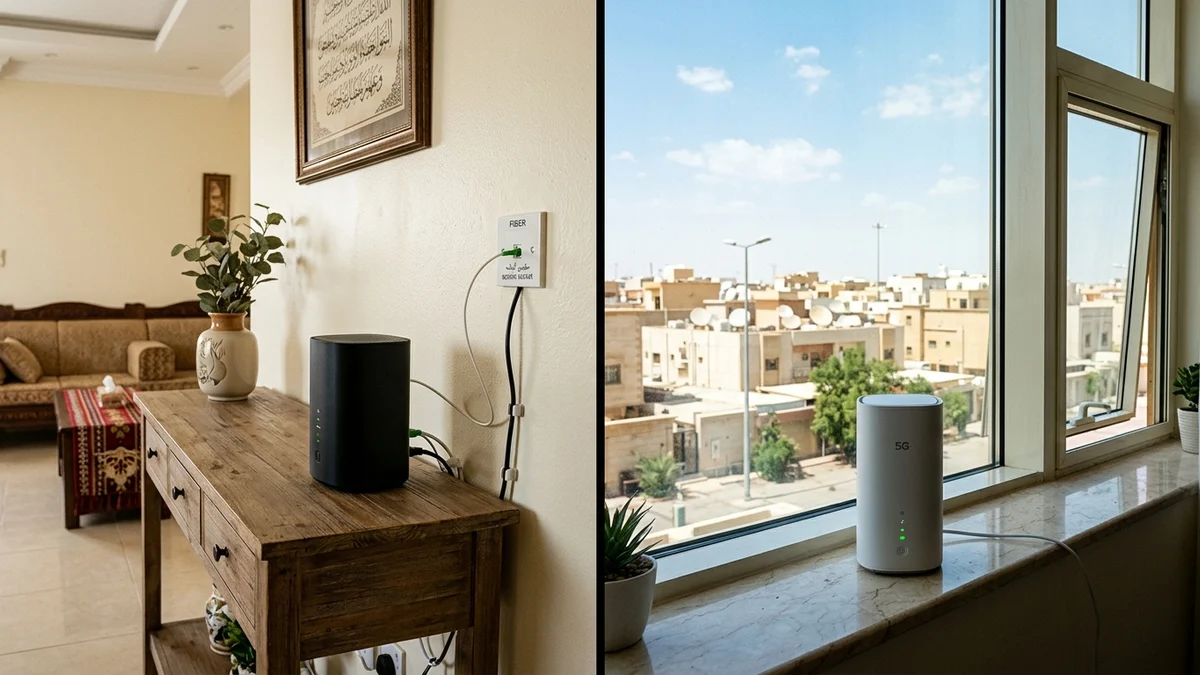
Short-term tenants, university students, corporate assignees on temporary contracts, and households residing in newly developed districts face a completely different operational equation. Standard short-term rental agreements frequently restrict drilling through walls or running surface-mounted raceways where internal telecommunications conduits are blocked. Furthermore, relocating an active FTTH line to a new house requires submitting a formal relocation order, paying transfer fees, and verifying that the destination building possesses a live optical splitter port. In these mobile or infrastructure-constrained contexts, a 5G FWA Customer Premises Equipment (CPE) router requires nothing more than an activated SIM card and an AC power outlet near an unobstructed window—allowing subscribers to unbox, connect, and later relocate their broadband service within minutes.
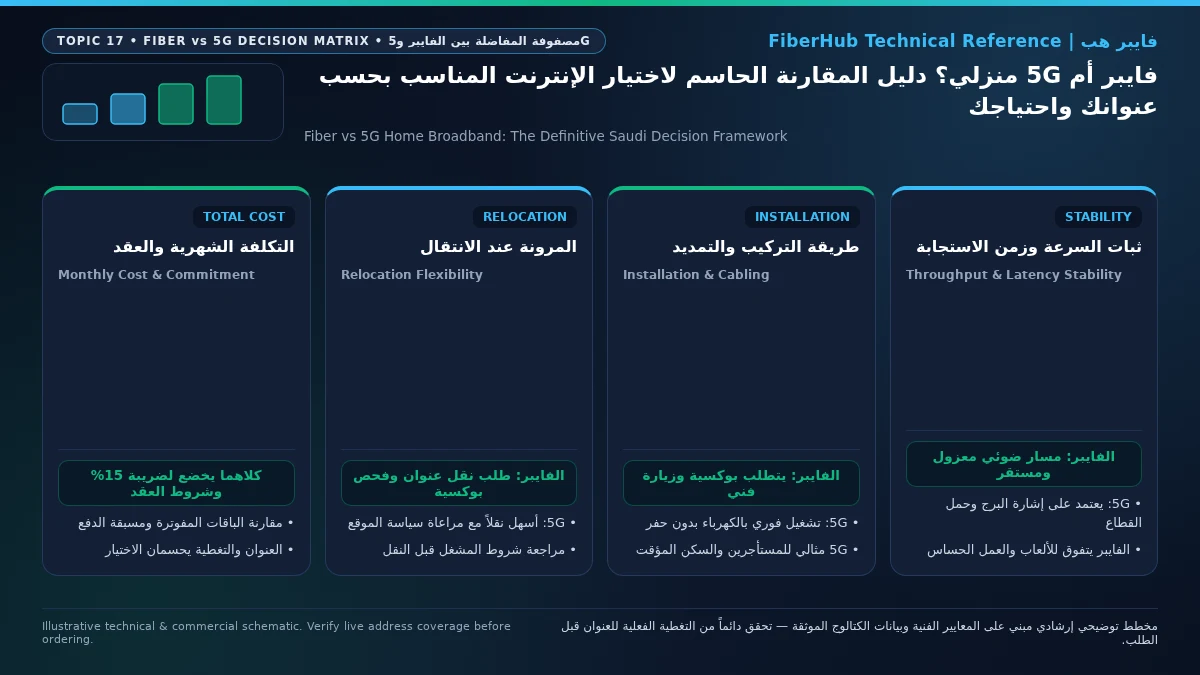
The following ten-point engineering and operational matrix contrasts both broadband architectures across the exact criteria that impact everyday household usability in the Kingdom:
| Decision Criterion | Fiber-to-the-Home (FTTH) | 5G Home Broadband (5G FWA) |
|---|---|---|
| Physical Transmission Medium | Single-mode silica glass fiber carrying laser light pulses | Over-the-air cellular radio waves (primarily 3GPP n78 C-Band at 3.5 GHz) |
| Mandatory Address Prerequisite | Active Optical Distribution Box (ODB) with an available splitter port | Proximity to an active 5G NR base station with strong RSRP and SINR values |
| Activation & Setup Lead Time | 24 to 72 business hours (requires field technician dispatch and fiber splicing) | Immediate same-day self-installation (plug-and-play once SIM and CPE arrive) |
| Indoor Wiring & Landlord Approval | Requires pulling internal drop fiber and mounting an indoor optical wall box | Zero indoor wiring or wall drilling (unless installing an optional outdoor PoE unit) |
| Peak-Hour Speed Consistency | Exceptionally stable; dedicated passive optical path unaffected by mobile users | Variable; shares sector airtime scheduler with neighborhood smartphones and routers |
| Upload Throughput & Symmetry | High, predictable upstream capacity on a dedicated optical wavelength | Constrained by TDD downlink-heavy slot ratios and indoor CPE transmit power limits |
| Baseline Latency & Jitter | Ultra-low and flat (2–6 ms local RTT with sub-millisecond jitter) | Moderate and variable (12–35 ms RTT with periodic radio scheduling jitter spikes) |
| Building Material & Weather Immunity | 100% immune to Low-E thermal glass, reinforced concrete, dust storms, and rain | Attenuated by metallic window coatings, thick masonry walls, and heavy dust/rain |
| Relocation & Portability | Tied to the physical ODB port; moving requires a formal transfer and coverage check | Highly portable across covered districts in alignment with ISP location policies |
| Suitability for Gaming & Cloud Work | Gold standard for competitive esports, 4K cloud CCTV, and heavy creator uploads | Strong for 4K streaming and general browsing; less stable for tick-sensitive gaming |
Physical Layer Architecture: Passive Optical Networks (GPON/XGS-PON) vs 5G Fixed Wireless Access
To understand why a 300 Mbps fiber connection frequently feels far more responsive during evening family usage than a 5G router that clocked 600 Mbps during an early-morning speed test, we must examine the underlying physical layer protocols standardized by the International Telecommunication Union (ITU-T) and 3GPP. In modern Saudi FTTH deployments—operating on GPON (ITU-T G.984) or next-generation XGS-PON (ITU-T G.9807)—data travels as modulated laser light inside a microscopic glass core from the provider's Optical Line Terminal (OLT) through passive, unpowered optical splitters directly to the Optical Network Terminal (ONT) inside your home.
Crucially, Passive Optical Networks separate downstream and upstream traffic using Wavelength Division Multiplexing (WDM). Downstream data flows on one dedicated laser wavelength (such as 1490 nm on GPON or 1577 nm on XGS-PON), while upstream data travels simultaneously in the opposite direction on a completely separate wavelength (1310 nm or 1270 nm). Because light inside a clad optical fiber is completely isolated from external electromagnetic noise, neighboring Wi-Fi routers, or cellular spectrum load, the physical link experiences a virtually zero bit-error rate (BER). Your connection does not degrade when nearby streets experience heavy traffic or when summer dust storms sweep across the city.

By contrast, 5G Fixed Wireless Access operates over licensed cellular spectrum—predominantly the 3.5 GHz mid-band (band n78)—using Time Division Duplexing (TDD). Under TDD radio architecture, the cell tower and your home router transmit on the exact same frequency channel, taking turns in rapid millisecond time slots. Because residential internet traffic is historically download-heavy, mobile network operators configure TDD frame structures to allocate the vast majority of time slots to Downlink (DL) transmission and only a small fraction to Uplink (UL) transmission.
Furthermore, radio waves propagating through the air between the base station sector antenna and an indoor 5G router encounter severe physical attenuation when passing through modern Saudi residential construction. Thick reinforced concrete slabs, exterior stone cladding, and double-glazed thermal windows coated with microscopic metal-oxide layers (Low-E glass designed to block solar infrared heat) reflect and absorb 3.5 GHz radio energy. When indoor Reference Signal Received Power (RSRP) drops and the Signal-to-Interference-plus-Noise Ratio (SINR) deteriorates, the 5G modem must step down its modulation coding scheme (dropping from 256-QAM to 64-QAM or 16-QAM) and rely on Hybrid Automatic Repeat Request (HARQ) retransmissions to recover corrupted data blocks—directly reducing real-world throughput and inflating latency.
Upload Consistency, Latency Stability, and Multi-User Household Contention
Most broadband shoppers compare packages solely by headline download speed, yet the true stress test of a Saudi household connection occurs between 8:00 PM and 1:00 AM when multiple family members use the network simultaneously. Imagine a typical evening: two televisions streaming 4K HDR football broadcasts, a professional syncing large cloud directories or participating in a video call, smart outdoor security cameras uploading continuous high-definition footage to cloud storage, and a console gamer playing an online match. Under this concurrent load, upload stability and latency under load determine whether the internet feels effortless or sluggish.
On FTTH fiber broadband, the dedicated upstream optical wavelength and deterministic Dynamic Bandwidth Allocation (DBA) ensure that outgoing traffic—including video conferencing streams, cloud backups, and TCP acknowledgment packets—flows without starving downstream responsiveness. Even when multiple devices actively transfer data, first-hop latency from the home ONT to the ISP gateway remains tightly bounded within a few milliseconds.
On 5G home broadband, concurrent multi-user contention exposes two structural bottlenecks:
- Uplink Power Budget Asymmetry: While a cellular macro tower broadcasts toward your house using high-gain sector antennas and high-wattage amplifiers, your indoor 5G CPE transmits back toward the tower using small internal antennas subject to strict regulatory transmit power limits (typically 23 dBm or 200 milliwatts). When the router sits deep inside a room, its outgoing signal suffers heavy penetration loss before reaching the tower, restricting real-world upload speeds even when download speeds appear healthy.
- Shared Sector Scheduling and Bufferbloat: During peak evening hours, your 5G router competes for air-interface Resource Blocks (RBs) against every smartphone and home router connected to that same cell sector. If one device in your home saturates the limited TDD uplink slots with a cloud backup or large file transfer, outgoing packets queue up inside the modem buffer, causing latency across the entire household to spike from 20 ms to over 150 ms.
Consequently, households with remote professionals, content creators, cloud surveillance arrays, or competitive gamers consistently experience markedly higher reliability on wired optical fiber—a trend consistently reflected in fixed versus mobile broadband performance benchmarks published by the Communications, Space and Technology Commission (CST).
Check 5G and fiber availability in your district
Home 5G performance depends on local sector coverage and window line-of-sight. Check your address options before committing.
Installation Lead Times, Indoor Wiring Realities, and Contract Portability
When evaluating practical deployment timelines and contract flexibility, the trade-offs between the two technologies shift noticeably. Ordering an FTTH line initiates a structured field engineering workflow. First, the service provider verifies that your building's Optical Distribution Box (ODB) is patched and active on the wholesale open-access network. Next, a field technician visits the property to measure optical power levels (typically verifying a clean signal between -15 dBm and -25 dBm at the splitter), pulls a bend-insensitive fiber drop cable through the building's internal telecommunications conduit into your living space, fusion-splices the termination into an indoor wall outlet, and provisions the ONT serial number.
When internal conduits are clear and the ODB port is ready, FTTH installation typically completes within 24 to 72 hours. However, in older apartment buildings or villas where subterranean PVC ducts have become pinched or blocked over time, technicians may require an electrician to clear the pathway or ask permission to route slim, surface-clipped fiber cabling along baseboards. Additionally, FTTH plans frequently bundle free installation and Wi-Fi 6 mesh hardware into 12- or 24-month commitment contracts; relocating mid-contract requires submitting a formal home-move request and confirming fiber readiness at the new address.
In contrast, 5G Fixed Wireless Access bypasses civil and indoor cabling hurdles entirely. Once courier delivery arrives or you pick up the router from a retail branch, activation is instantaneous: insert the nano-SIM, plug the CPE into power near a window facing the nearest cell tower, and connect your devices over Wi-Fi or Ethernet. Even in residences where Low-E thermal windows block indoor signal penetration, operators offer weatherproof outdoor 5G receivers (mounted on a balcony rail or rooftop mast) linked to the indoor Wi-Fi router via a single thin Power-over-Ethernet (PoE) cable. For tenants who need immediate internet connectivity on move-in day or residents in districts awaiting fiber deployment, 5G FWA eliminates installation waiting periods.
Practical Scenario Decision Tree: Six Real-World Saudi Household Profiles
To translate these engineering principles into an immediate, actionable decision for your address, match your household profile against these six common scenarios in Saudi Arabia:
- Owner-Occupied Villa or Long-Term Family Apartment with an Active ODB: Choose FTTH Fiber without hesitation. For households running 10 to 25 simultaneous connected devices, multiple 4K streams, smart home automation, and cloud backups, optical fiber provides rock-solid evening throughput that never degrades when neighborhood mobile traffic peaks. Pair the ONT with wired Ethernet backhaul or a tri-band Mesh Wi-Fi system to cover every floor.
- Newly Constructed District Where Fiber Trenches Exist but ODB Ports Are Not Yet Active: Choose 5G Home Broadband as your immediate bridge solution. Use your smartphone or router diagnostics to locate the window with the highest SINR reading facing the nearest 5G tower, and select a flexible contract term so you can seamlessly transition to FTTH once your street cabinet goes live.
- Short-Term Tenant, Student, or Frequently Relocating Professional: Choose 5G Home Broadband. Avoiding wall drilling, technician scheduling, and fixed-line relocation checks saves time and prevents early-termination fees when moving between rental properties every 6 to 12 months.
- Competitive Online Gamer or Live-Streaming Content Creator: Choose FTTH Fiber wired via Cat6 Ethernet. Online esports titles and high-bitrate Twitch or YouTube live streams require zero packet loss, flat sub-millisecond jitter, and unthrottled upstream bandwidth that cellular TDD radio frames cannot guarantee during prime time.
- Thick-Walled Residence with Low-E Thermal Glass and No Fiber Coverage: Choose 5G Home Broadband with an External Outdoor CPE Antenna. Relying on an indoor 5G router behind thermally coated glass often cuts speeds by more than half; mounting an outdoor PoE receiver captures unobstructed line-of-sight n78 signals before building materials attenuate them.
- Mission-Critical Executive Home Office Requiring Near-100% Uptime: Deploy Primary FTTH Fiber with 5G Cellular Failover. Connect both a primary fiber ONT and a secondary 5G modem to a Dual-WAN gateway so your workstation automatically fails over within seconds if street excavation ever severs an underground cable.
Ready to narrow down the exact packages available for your home? Use our broadband plan comparison tool to filter verified fiber and 5G packages side by side.
Frequently Asked Questions: Choosing Between Fiber and 5G Home Broadband
How can I verify whether my building already supports FTTH fiber or requires 5G home broadband?
You can confirm readiness in two rapid steps. First, visually inspect your property's exterior perimeter wall or ground-floor utility room for a gray or white metallic Optical Distribution Box (ODB) bearing an alphanumeric cabinet plate ID. Second, enter your Saudi National Address or map pin on our coverage verification portal, which cross-references wholesale optical network records and cellular tower footprints to show whether an active fiber port is ready for immediate technician dispatch or if 5G FWA is currently the fastest deployment option for your location.
Compare home 5G plans, router terms, and billing
Review prepaid vs postpaid 5G tiers, CPE router conditions, and operator contract terms side by side.
Do dust storms, summer heat, or heavy rain affect 5G home internet compared to fiber?
Underground optical fiber is completely impervious to weather conditions because laser signals travel inside sealed subterranean ducts all the way into your house. In contrast, 5G FWA transmits radio waves through the open atmosphere. While 3.5 GHz mid-band signals handle normal weather well, severe Saudi dust storms (haboobs) and heavy downpours can introduce atmospheric signal attenuation and multipath scattering—particularly if your residence sits near the outer edge of a cell sector's footprint or relies on an outdoor unit exposed to extreme direct summer solar heating.
Why does my neighbor's 5G router slow down at 10 PM while my fiber connection stays at full speed?
The difference stems from medium contention and radio resource scheduling. Every 5G router and smartphone connected to the same cellular tower sector shares a finite pool of radio spectrum time slots; between 9:00 PM and 1:00 AM, when hundreds of neighborhood residents stream 4K video and download updates simultaneously, the base station scheduler divides airtime across all active users. FTTH fiber, conversely, runs over a dedicated passive optical tree engineered specifically for a fixed number of residential ports with high backhaul capacity, ensuring your contracted speed remains consistent around the clock.
Can I start with 5G home internet now and switch to fiber once my street cabinet is activated?
Yes, starting with 5G FWA and migrating to FTTH later is one of the most practical strategies for residents moving into newly developed urban districts across Saudi Arabia. If you anticipate fiber arriving at your building within a few months, opt for a no-contract or prepaid 5G home plan, or verify with your chosen telecom provider whether they support an internal technology upgrade path that waives early-termination penalties when transitioning from a 5G home contract to an FTTH fiber plan under the same provider account.
Need fast home internet without waiting for trenching?
Check your address first to confirm whether fiber is ready or compare eligible home 5G plans for your location.
Editorial Transparency & Neutrality Notice:
This guide is provided for comparison and decision support. It does not constitute final address coverage confirmation, binding operator pricing, or regulatory accreditation. Always verify final plan terms and box readiness before completing your subscription request.