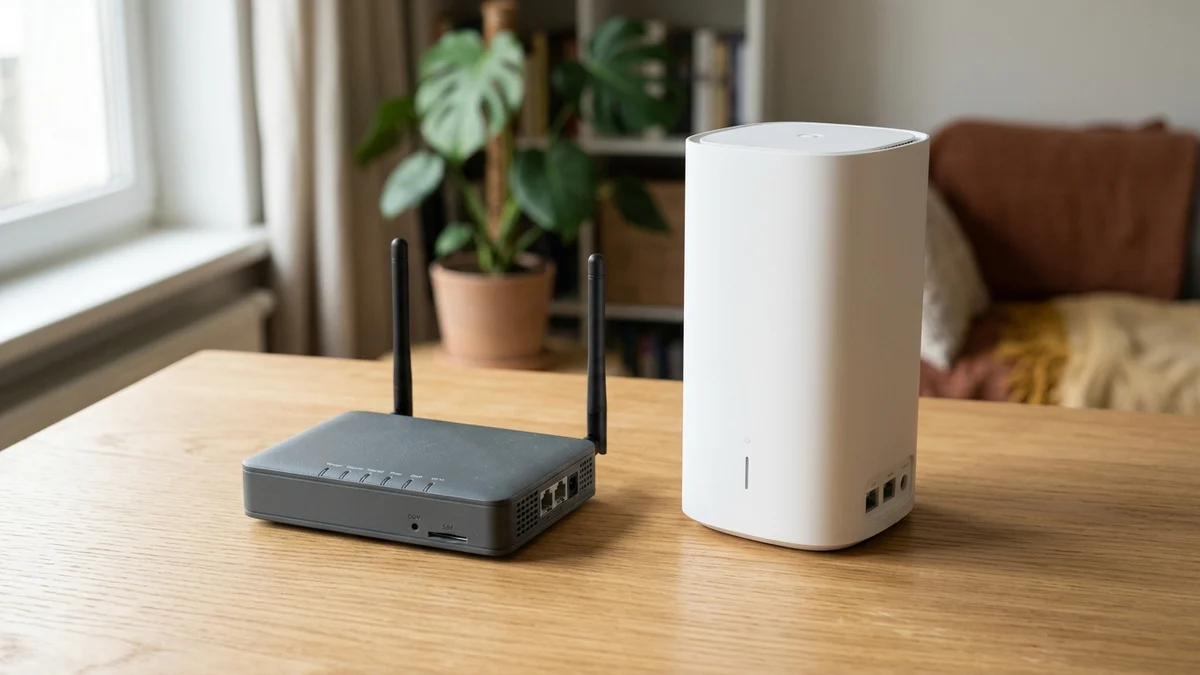
- Why Legacy 4G Home Routers Choke Every Evening in Saudi Neighborhoods
- The Core Engineering Leap: 4G LTE vs. 5G New Radio (5G NR)
- Modem Generation Breakdown: From LTE Cat4, Cat6, and Cat12 to 5G Sub-6GHz Gateways
- Real-World Impact on Daily Saudi Household Scenarios
- Economic Appraisal in Saudi Arabia: Plan Pricing and Value Comparison
- When You Should Hold Off on Upgrading to 5G (And What to Choose Instead)
- Smooth Migration Checklist: Upgrading from 4G to 5G Without Downtime or Fees
- Frequently Asked Questions About 5G vs. 4G Home Broadband
- Does a 5G home router consume more gigabytes of data than a 4G router for the same tasks?
- What happens to my home 5G router if the local 5G tower signal drops temporarily?
- Do 5G radio waves penetrate thick concrete walls better than 4G signals?
- Can I keep my old 4G subscription and just buy an unlocked 5G router from a retail store?
- How much does gaming ping improve when switching from a 4G router to a 5G router?
Yes—upgrading from a legacy 4G LTE home router to a 5G Fixed Wireless Access (FWA) home broadband plan in Saudi Arabia is decisively worth it if your address has active mid-band 5G (Band n78) coverage and your household runs multiple 4K video streams, cloud backups, remote work video calls, or gaming consoles simultaneously. Making the switch moves your home network off narrow, heavily congested 20 MHz 4G channels—which routinely bog down to 10–35 Mbps during evening peak hours—onto wide 100 MHz 5G New Radio channels capable of delivering 200 to 500+ Mbps with roughly half the air-interface latency, often for virtually the same monthly subscription fee.
Thousands of households across Saudi cities and governorates still rely on aging 4G or 4G+ (LTE-Advanced) routers purchased years ago, wondering whether 5G home broadband is merely a marketing label for higher peak speed tests or a genuine architectural leap in day-to-day stability. The answer lies in the fundamental physics of radio spectrum allocation, tower antenna arrays, and modern router hardware.

Why Legacy 4G Home Routers Choke Every Evening in Saudi Neighborhoods
To understand why an older 4G home router delivers acceptable 50 Mbps speeds at 10:00 AM yet grinds to a halt between 8:00 PM and midnight, we have to examine how cellular operators allocate LTE spectrum. Across Saudi Arabia, 4G LTE networks operate on frequency bands such as 700 MHz (Band 28), 1800 MHz (Band 3), 2100 MHz (Band 1), and 2300 MHz (Band 40).
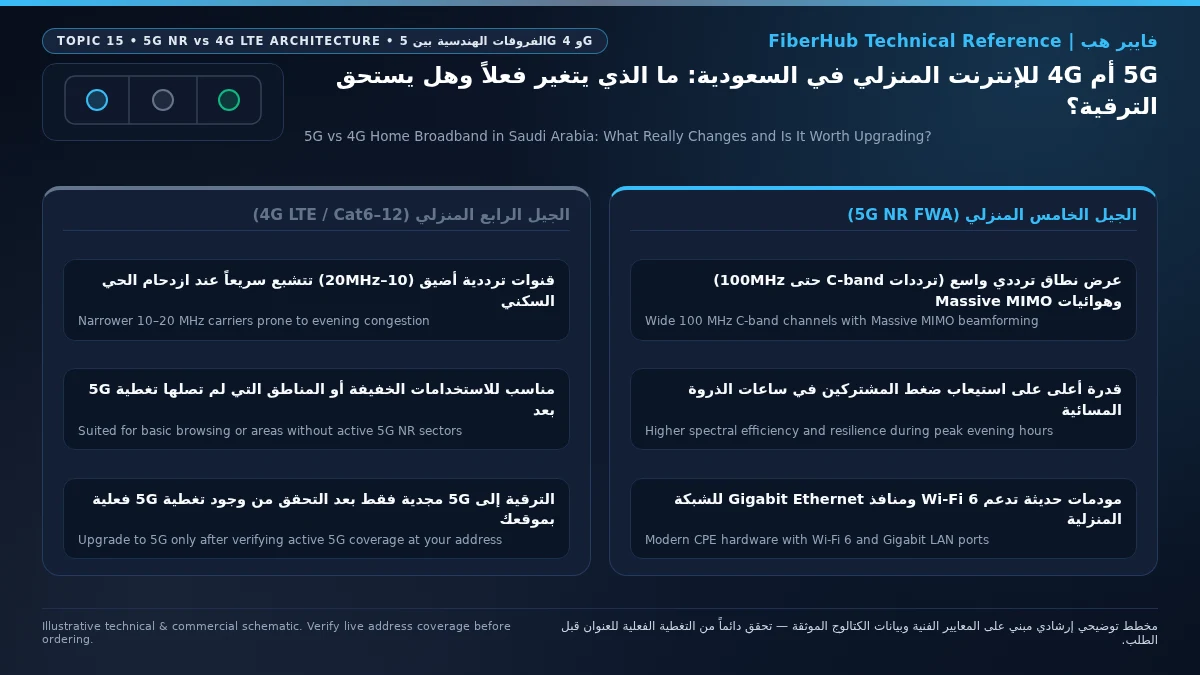
On these legacy LTE bands, a single radio carrier is restricted to a maximum channel width of 10 MHz to 20 MHz. Even when an advanced 4G+ router (such as an LTE Cat6 or Cat12 unit) bonds two or three frequencies together via Carrier Aggregation, the total combined spectrum rarely exceeds 40 to 60 MHz. Worse still, those exact same 4G bands carry the mobile voice and data traffic of every smartphone, connected vehicle, and point-of-sale terminal moving through your neighborhood.
When residents return home in the evening and start streaming high-definition video, hundreds of smartphones compete with your home 4G router for time-frequency resource blocks on those narrow 20 MHz channels. The base station scheduler is forced to slice available bandwidth into tiny fractions, causing your home connection to plummet and latency to spike. Before deciding on an upgrade, you can verify the exact 5G and fiber infrastructure serving your street via our home broadband coverage checker.
The Core Engineering Leap: 4G LTE vs. 5G New Radio (5G NR)
5G New Radio (5G NR), standardized under 3GPP Release 15 and Release 16 specifications, was specifically engineered to solve residential wireless congestion through four structural advancements over 4G LTE:
- Massive Contiguous Channel Bandwidth (100 MHz on Band n78): Operating in the 3.5 GHz C-band (Band n78), Saudi operators deploy contiguous 80 MHz to 100 MHz TDD channels. A single 5G n78 carrier provides five times the raw highway width of a standard 20 MHz 4G channel without needing to stitch fragmented low-band carriers together.
- Faster Sub-Carrier Spacing (Numerology): While 4G LTE is locked into a rigid 15 kHz sub-carrier spacing with 1-millisecond subframes, mid-band 5G NR utilizes 30 kHz sub-carrier spacing and flexible mini-slots. Halving the symbol duration cuts air-interface transmission delay in half, dropping typical unloaded cellular ping from 35–55 ms on 4G down to 12–22 ms on 5G.
- 64T64R Massive MIMO and Dynamic Beamforming: Traditional 4G tower sectors use passive antennas (2T2R or 4T4R) that spray radio energy broadly across an entire neighborhood like a floodlight. Modern Saudi 5G towers deploy active 64-Transmitter, 64-Receiver (64T64R) Massive MIMO panels that form narrow, laser-like beams aimed directly at individual 5G home routers, multiplying spectral efficiency and isolating your connection from neighbor interference.
- Sustained 256-QAM High-Order Modulation: Thanks to concentrated beamforming signal-to-noise ratios, 5G links maintain 256-QAM modulation (8 bits per symbol) far more consistently than wide-beam 4G sectors.
| Technical & Practical Dimension | Legacy 4G / 4G+ Home Broadband (LTE-A) | Modern 5G Home Broadband (5G NR FWA) |
|---|---|---|
| Primary Spectrum & Channel Width | Narrow 10–20 MHz channels on 700/1800/2100 MHz | Wide 80–100 MHz contiguous channel on 3500 MHz (Band n78) |
| Real-World Evening Peak Download | 10 to 45 Mbps (heavily degraded by mobile phone load) | 150 to 500+ Mbps (depending on plan tier and signal quality) |
| Typical Upload Throughput | 5 to 20 Mbps | 30 to 100+ Mbps |
| Unloaded Domestic Latency (Ping) | 32 to 60 ms (prone to severe spikes under load) | 12 to 25 ms in healthy coverage zones |
| Tower Antenna Architecture | 2x2 or 4x4 MIMO wide-sector flood beam | 64T64R Massive MIMO with targeted 3D Beamforming |
| Included Indoor Router Wi-Fi Standard | Wi-Fi 4 (802.11n) or early Wi-Fi 5 (802.11ac) | Wi-Fi 6 (802.11ax) with OFDMA, MU-MIMO, and Gigabit ports |
| Multi-Screen Household Resilience | Struggles past two 4K streams or one large download | Effortlessly handles 4–6 concurrent 4K streams and cloud work |
Modem Generation Breakdown: From LTE Cat4, Cat6, and Cat12 to 5G Sub-6GHz Gateways
To appreciate why replacing your aging router hardware transforms your connection, it helps to examine the specific LTE modem categories that dominated Saudi homes over the past decade compared to modern 5G CPEs:
- LTE Category 4 (Cat4) Routers: Early single-carrier routers (such as the classic Huawei B310/B315 series) cannot aggregate multiple frequencies at all. Although rated for 150 Mbps on paper, a single 20 MHz 4G carrier operating at 64-QAM with basic 2x2 MIMO antennas typically delivers only 5 to 18 Mbps during evening hours in Saudi cities today.
- LTE Category 6 and Category 12 (Cat6 / Cat12) Routers: Popularized as "4G+ Advanced" gateways (such as the Huawei B525, B535, and B715), these units bond two or three LTE bands together (2CA or 3CA) and reach 40 to 90 Mbps during quiet morning hours. However, because all three aggregated bands still reside inside the congested mobile 4G spectrum shared with smartphones on the street, all three bands saturate simultaneously after 8:00 PM.
- Modern 5G Sub-6GHz CPE Gateways: Powered by multi-gigabit baseband platforms (such as Qualcomm Snapdragon X62/X65, Balong 5000, or MediaTek T750/T830), contemporary 5G routers bond multiple 4G anchor bands with a 100 MHz-wide 5G n78 carrier (EN-DC) or connect directly to a 5G Standalone (SA) core using 4x4 or 8x8 internal MIMO antenna arrays.
For this exact hardware reason, inserting a new 5G SIM card into an old 4G router forfeits over 90% of the network upgrade. Legacy 4G routers physically lack the 3500 MHz RF transceivers and filters required to detect Band n78, and their aging processors, 100 Mbps Fast Ethernet ports, and legacy Wi-Fi 4/5 radios bottleneck modern smart homes once more than 12 to 15 devices connect.
Real-World Impact on Daily Saudi Household Scenarios
Beyond radio engineering metrics, the practical leap from a 4G router to a 5G home gateway shows up immediately across four everyday household activities:
- Live Sports Streaming During Peak Hours (Saudi Pro League & Major Tournaments): When millions of viewers across Riyadh, Jeddah, and the Eastern Province tune into live football broadcasts on Shahid VIP or digital sports platforms at 9:00 PM, neighborhood cellular traffic surges. On 4G routers, this evening surge causes constant buffering wheels and forces video players to downgrade resolution to blurry 480p. On a 5G n78 sector, the 100 MHz channel width and Massive MIMO beamforming sustain crisp 4K 60fps HDR streams across multiple living-room televisions simultaneously.
- Smart Home Cloud Cameras and Automated Phone Backups: Modern Saudi homes frequently run outdoor and indoor smart security cameras alongside automatic iCloud, Google Photos, and WhatsApp cloud backups. On a 4G router whose evening upload speed drops to 3 Mbps, a single smartphone backing up a video clip saturates the uplink and freezes web browsing for everyone else. Modern 5G home plans provide 30 to 200 Mbps of upload capacity, absorbing background cloud syncs effortlessly.
- Massive Console and PC Game Updates: Downloading an 85 GB PlayStation 5, Xbox Series X, or PC game update takes nearly 10 hours on a 20 Mbps 4G router while paralyzing household internet; on a 350 Mbps 5G connection, that same 85 GB patch finishes in under 35 minutes.
- Remote Work and Virtual Classrooms: Cutting air-interface latency from 50 ms down to under 18 ms eliminates awkward voice overlap and screen-sharing lag on Microsoft Teams and Zoom calls.
Check 5G and fiber availability in your district
Home 5G performance depends on local sector coverage and window line-of-sight. Check your address options before committing.
Economic Appraisal in Saudi Arabia: Plan Pricing and Value Comparison
When evaluating the financial side of upgrading in the Saudi market, the numbers strongly favor 5G: modern postpaid and prepaid 5G home broadband plans—which include a free Wi-Fi 6 5G CPE under standard commitment terms—cost virtually the same as (or even less than) legacy unlimited 4G data SIMs.
Entry-level speed-tiered 5G home plans in Saudi Arabia start between 217.35 SAR and 230 SAR per month (inclusive of 15% VAT) for 100 to 140 Mbps, while the flagship 200 to 400 Mbps unlimited home 5G tier sits at a standardized 287.5 SAR per month across major operators. For subscribers who already own an unlocked 5G router and want a contract-free upgrade, eSIM-only plans such as STC Baity 5G Basic eSIM (200 Mbps at 299 SAR/month with a 1-month commitment) provide instant activation. You can explore current operator offers on our verified 5G home broadband catalog or compare plans head-to-head using our interactive plan comparison tool:
| Operator | Verified 5G Home Catalog Plan | Download / Upload Speed | Monthly Price (Incl. 15% VAT) | Commitment & Router Hardware |
|---|---|---|---|---|
| Salam | Salam HomeFi 140 5G | 140 / 30 Mbps | 217.35 SAR | 12 Months — Wi-Fi 6 5G Router Included |
| Zain | Zain 5G+ Home Basic (100 Mbps) | 100 / 25 Mbps | 228.85 SAR | 18 Months — Wi-Fi 6 5G Router Included |
| Mobily | Mobily Home 5G 100 Mbps | 100 / 25 Mbps | 230 SAR | 12 Months — Wi-Fi 6 5G Router Included |
| STC | STC Baity 5G Home Wireless Unlimited | 300 / 50 Mbps | 287.5 SAR | 12 Months — Wi-Fi 6 5G Router Included |
| Mobily | Mobily 5G Wireless Home Broadband | 300 / 50 Mbps | 287.5 SAR | 12 Months — Wi-Fi 6 5G Router Included |
| Zain | Zain 5G Home Pro (400 Mbps) | 400 / 50 Mbps | 287.5 SAR | 12 Months — Wi-Fi 6 5G Router Included |
| Salam | Salam HomeFi 200 5G | 200 / 40 Mbps | 287.5 SAR | 12 Months — Wi-Fi 6 5G Router Included |
| Zain | Zain 5G Max Home (1000 Mbps) | 1000 / 200 Mbps | 299 SAR | 12 Months — Wi-Fi 6 5G Router Included |
National broadband benchmarks published by the Communications, Space and Technology Commission (CST) confirm that 5G deployments across the Kingdom deliver several-fold higher median download speeds than 4G LTE networks. You can also view all Saudi home internet packages to compare wireless options against fiber optics.
When You Should Hold Off on Upgrading to 5G (And What to Choose Instead)
Despite 5G's overwhelming superiority in urban and suburban areas, three specific scenarios warrant caution before upgrading from 4G to 5G:
- Rural or Highway Locations Without Band n78 Coverage: In remote villages, desert rest houses (istirahat), or agricultural areas served only by long-range 700 MHz or 800 MHz 4G towers, buying a 5G plan will not create 5G speeds because the local tower lacks 3.5 GHz radios.
- Windowless Basements or Deep Interior Apartments: Because 3.5 GHz 5G waves attenuate much faster through concrete than 700 MHz 4G waves, a basement apartment with zero exterior window clearance may struggle to lock onto 5G indoors unless an outdoor rooftop antenna is wired in.
- Buildings Already Equipped with FTTH Fiber Boxes: If your building already has an active optical distribution box (ODB) on the wall, skip wireless upgrades altogether and order a 300 Mbps FTTH fiber plan for the exact same 287.5 SAR monthly price.
Smooth Migration Checklist: Upgrading from 4G to 5G Without Downtime or Fees
When transitioning your household from an older 4G setup to a modern 5G home broadband package, following a structured migration sequence prevents service interruptions and avoids unnecessary early termination charges:
- Request an In-Operator Technology Upgrade Rather Than a Cancellation: If you are currently mid-contract on a postpaid 4G home plan with STC, Mobily, Zain, or Salam, do not submit a line termination request first. Instead, contact customer care or visit a branch to request a technology tier upgrade from 4G to 5G Home. Under standard operator policies, upgrading internally to an equivalent or higher-tier 5G package typically waives early cancellation penalties on the legacy contract and dispatches your new Wi-Fi 6 5G CPE seamlessly.
- Verify 5G Standalone (SA) USIM or eSIM Provisioning: Physical SIM cards issued more than five years ago often lack the cryptographic authentication applets required to register on a 5G Standalone (5G SA) core network. Ensure your upgrade includes a freshly provisioned 5G USIM card or an active eSIM profile so your new router is not restricted to legacy Non-Standalone anchor mode.
- Clone Your Legacy 2.4 GHz SSID for Smart Home Continuity: If your house has dozens of smart plugs, wireless printers, robot vacuums, and CCTV cameras bound to your old 4G router, configure the 2.4 GHz Wi-Fi network on your new 5G router to use the exact same SSID name and WPA2 password as your retired 4G unit, while creating a brand-new 5 GHz SSID for phones, laptops, and 4K TVs. Every smart home sensor will reconnect automatically the moment you unplug the old router.
- Repurpose Your Retired 4G Router as a Wired Access Point or Switch: Rather than discarding a functional 4G router, remove its SIM card, log into its admin settings to disable the built-in DHCP Server, and connect an Ethernet cable from a LAN port on your new 5G router to a LAN port on the old unit in a distant room or rooftop annex to serve as a secondary wired switch and auxiliary Wi-Fi access point.
Frequently Asked Questions About 5G vs. 4G Home Broadband
Does a 5G home router consume more gigabytes of data than a 4G router for the same tasks?
No—downloading a 2 GB file consumes exactly 2 GB of data whether transmitted over 4G or 5G. However, because 5G delivers much higher speeds, adaptive video apps (YouTube, Netflix, Shahid, TikTok) automatically switch from 720p or 1080p up to 4K Ultra HD, which consumes three to four times more data per hour. Fortunately, mainstream Saudi home 5G plans are truly unlimited without data caps.
Compare home 5G plans, router terms, and billing
Review prepaid vs postpaid 5G tiers, CPE router conditions, and operator contract terms side by side.
What happens to my home 5G router if the local 5G tower signal drops temporarily?
Every certified 5G CPE supplied by Saudi operators includes full backward compatibility with 4G LTE-Advanced (Cat19/Cat20). If the 5G n78 carrier experiences maintenance or severe weather attenuation, the router automatically falls back to multi-carrier 4G+ within seconds so your home stays online.
Do 5G radio waves penetrate thick concrete walls better than 4G signals?
No—physically, lower frequencies penetrate dense materials better than higher frequencies. A 700 MHz 4G signal penetrates interior concrete walls more easily than a 3500 MHz 5G signal. That is why a 5G home router should always be placed near an exterior window rather than hidden in an interior hallway.
Can I keep my old 4G subscription and just buy an unlocked 5G router from a retail store?
While an unlocked retail 5G router (which typically costs 1,100 to 1,600 SAR upfront) will work if your old SIM profile has 5G access provisioned, many legacy 4G home plans are throttled or locked at the billing level. Subscribing to an official home 5G plan gives you an uncapped 5G profile and includes the Wi-Fi 6 router at no extra upfront device charge.
How much does gaming ping improve when switching from a 4G router to a 5G router?
Under healthy indoor signal conditions, switching from 4G LTE to 5G NR typically cuts domestic unloaded ping from 38–60 ms down to 14–24 ms, while drastically reducing the 200+ ms lag spikes that occur on 4G whenever another family member starts watching a video.
Need fast home internet without waiting for trenching?
Check your address first to confirm whether fiber is ready or compare eligible home 5G plans for your location.
Editorial Transparency & Neutrality Notice:
This guide is provided for comparison and decision support. It does not constitute final address coverage confirmation, binding operator pricing, or regulatory accreditation. Always verify final plan terms and box readiness before completing your subscription request.