
- 1. The Real Bandwidth Equation: How Many Megabits Does Your Household Actually Consume?
- 2. The Upload Ratio Factor: Why Upstream Speed Matters as Much as Download
- 3. True Cost Accounting: 15% VAT Math and Total Annual Commitment Value
- 4. Postpaid Commitments vs. Prepaid Flexibility: Choosing the Right Contract Structure
- 5. Why Your National Address and Open Access Box Dictate Eligible Plans
- 6. Don't Pay for Bandwidth Your Indoor Wi-Fi Cannot Deliver
- Frequently Asked Questions About Choosing a Saudi Fiber Plan
- Is a 100 Mbps or 200 Mbps fiber plan enough for a family in Saudi Arabia in 2026?
- Do Saudi home fiber plans have a Fair Usage Policy (FUP) or monthly data cap?
- Does upgrading from 300 Mbps to 1 Gbps lower my Ping in online games?
- Can I start with a 300 Mbps plan and upgrade to 500 Mbps or 1 Gbps later without penalty?
If your monthly home internet budget is strictly capped and you want to know what speed and plan your household actually needs without overpaying, the practical benchmark in the 2026 Saudi broadband market is straightforward: a 300 Mbps fiber plan (priced between 279 SAR and 287.50 SAR per month including 15% VAT) is the optimal price-to-performance sweet spot for roughly 75% of Saudi households with 3 to 6 residents. If your top priority is minimizing monthly spend for a smaller apartment or light usage (1 to 3 residents), Mobily Fiber Postpaid 200 at 230 SAR/month (VAT inclusive) is the lowest verified postpaid entry point on optical fiber. Conversely, stepping up to the 500 Mbps tier (345 to 402.50 SAR/month) or 1 Gbps / 1000 Mbps tier (460 to 949 SAR/month) is only justified when your home regularly runs massive concurrent game downloads, 4K content creation uploads, or multi-floor smart-home workloads across more than 15 active devices simultaneously.
However, choosing the right fiber package in Saudi Arabia requires looking past the headline download number on promotional banners. Five operational variables determine whether a plan delivers genuine value at your specific address: the upload speed ratio governing video calls and cloud backups, contract structure (12- or 18-month postpaid commitment versus prepaid flexibility), 15% ZATCA Value-Added Tax (VAT) math over a full annual cycle, Open Access cabinet port readiness at your National Address, and whether your indoor Wi-Fi topology can actually carry the speed you pay for. This guide provides a structured, engineering-grounded framework to match your household profile to verified 2026 Saudi operator tariffs.

1. The Real Bandwidth Equation: How Many Megabits Does Your Household Actually Consume?
One of the most common mistakes subscribers make when shopping for home broadband is adding up the theoretical maximum consumption of every smartphone, tablet, television, and laptop in the house and assuming a family of five automatically requires a 1 Gbps connection. In residential network engineering, the sizing metric that matters is not total idle Wi-Fi associations, but Peak Concurrent Throughput—typically the evening window between 8:00 PM and 11:30 PM when family members stream, game, and browse at the exact same time.
To size your fiber connection accurately, examine the real-world bitrate requirements of everyday digital activities in a modern Saudi home:
- 4K UHD Video Streaming (Shahid VIP, Netflix, YouTube, Apple TV+): A single 4K stream at 60 frames per second consumes 25 to 35 Mbps of sustained download throughput, with brief initial buffering spikes reaching 50 Mbps for a few seconds when playback starts.
- Competitive Online Gaming (EA Sports FC, Call of Duty, Fortnite, Valorant): Active gameplay itself exchanges compact state packets requiring only 3 to 8 Mbps downstream and upstream; what matters during matches is low latency (Ping) and zero packet loss. However, downloading game patches and season updates—which routinely weigh 60 GB to 120 GB on PlayStation 5, Xbox, and PC—will saturate whatever bandwidth is available. On a 100 Mbps line, an 80 GB update takes roughly 1 hour and 50 minutes; on a 300 Mbps line, it finishes in about 37 minutes; and on a 500 Mbps line, it completes in roughly 22 minutes.
- Remote Work, E-Learning, and Video Conferencing (Microsoft Teams, Zoom, Webex): A high-definition 1080p video call with screen sharing requires 4 to 8 Mbps symmetrically (both download and upload). While modest in raw megabits, real-time voice and video streams are highly sensitive to upstream congestion if another device on the network saturates the upload pipe.
- Smart Home IoT and Cloud Security Cameras (CCTV): Smart thermostats and lighting bridges consume less than 1 Mbps combined. However, exterior 2K or 4K IP security cameras uploading continuous footage to cloud storage consume 4 to 10 Mbps of sustained upload bandwidth per camera 24 hours a day.
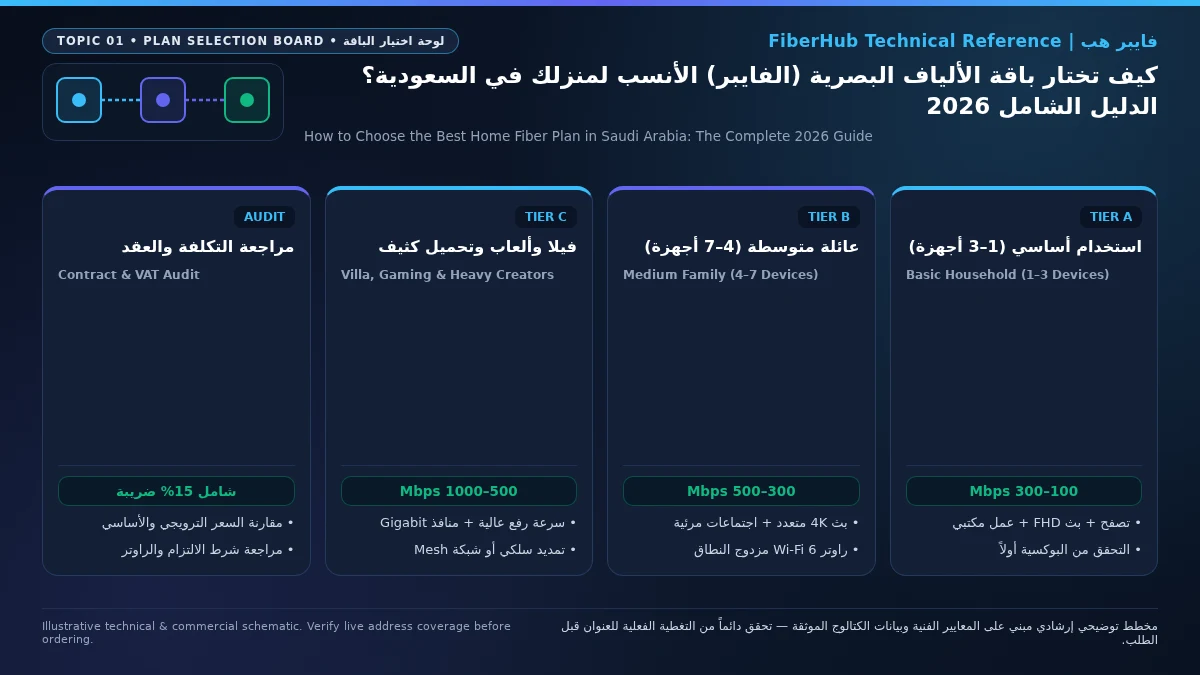
| Household Profile & Living Space | Peak Concurrent Users & Active Devices | Typical Evening Workload in a Saudi Home | Recommended Speed Tier (Download / Upload) | Monthly Price Range in KSA (15% VAT Included) | Verified Catalog Benchmark Plans (2026) |
|---|---|---|---|---|---|
| Singles, Couples & Compact Apartments (Budget Focus) | 1–2 users (3–6 active devices) | Web browsing, 1x 4K TV stream, remote office work, standard video calls | 100 to 200 Mbps (25–50 Mbps upload) | 230.00 – 287.50 SAR | Mobily Fiber Postpaid 200 (230 SAR), STC Baity Fiber 100 (287.50 SAR) |
| Standard Saudi Family (Best Value Sweet Spot) | 3–6 users (8–15 active devices) | 2–3 simultaneous 4K streams, gaming console, remote work/study, 2 cloud cameras | 300 Mbps (100 Mbps upload) | 279.00 – 345.00 SAR | Zain Fiber Home Plus 300 (279 SAR), Salam Fiber 300 (287.50 SAR), STC Baity Fiber Basic 300 (287.50 SAR), Mobily Fiber Postpaid 300 (345 SAR) |
| Large Families, Villas, Gamers & Creators | 6–10 users (15–25 active devices) | 4x 4K streams, frequent 100 GB+ game downloads, 4K uploads, multi-camera CCTV | 400 to 500 Mbps (100–200 Mbps upload) | 345.00 – 460.00 SAR | Salam Fiber 500 (345 SAR), Zain Fiber Home Premium 500 (389 SAR), Salam Fiber Gaming 500 (399 SAR), STC Baity Fiber Stream 500 (402.50 SAR), Mobily Fiber Gamers 500 (402.50 SAR) |
| Multi-Floor Executive Villas & Heavy Workstation Use | 10+ users (25+ active devices) | Multi-room heavy transfers, home NAS servers, uncompressed media production | 1000 Mbps / 1 Gbps (300 Mbps upload) | 460.00 – 949.00 SAR | Salam Fiber 1000 (460 SAR), STC Baity Fiber Max 1 Gbps (920 SAR), Mobily Fiber Postpaid 1GB (920 SAR), Zain Fiber Home Black 1 Gbps (949 SAR) |
Looking closely at the verified tariff table reveals a critical market anomaly that every buyer should know: in STC's 2026 catalog, STC Baity Fiber Basic (300 Mbps download / 100 Mbps upload) is priced at 287.50 SAR/month, which is the exact same monthly price as the older STC Baity Fiber 100 (100 Mbps download / 25 Mbps upload) at 287.50 SAR/month. Choosing 300 Mbps over 100 Mbps triples your download capacity and quadruples your upload speed for zero additional riyals at STC, Salam (287.50 SAR), or Zain (279 SAR). You can inspect every operator's current tier side by side on our home broadband comparison page.
2. The Upload Ratio Factor: Why Upstream Speed Matters as Much as Download
Residential FTTH networks in Saudi Arabia operate over GPON (Gigabit Passive Optical Network) architecture using asymmetric bandwidth profiles, where upstream throughput is provisioned at roughly 25% to 40% of the downstream rate. Because marketing campaigns emphasize the download figure, many subscribers overlook upload capacity until their household experiences unexplained lag during work hours:
- Simultaneous Video Calls and Interactive E-Learning: On a legacy 100 Mbps plan with only 25 Mbps upload, a single smartphone automatically backing up 4K family videos to iCloud or Google Photos during a Microsoft Teams meeting can saturate the entire upstream channel. When upstream capacity hits 100%, outgoing TCP acknowledgment packets (ACKs) are delayed, causing voice dropouts and frozen webcams across the house.
- The 100 Mbps Upload Jump at the 300 Mbps Tier: Upgrading from a 100/25 Mbps or 200/50 Mbps tier to 300 Mbps elevates your upload speed to a full 100 Mbps across all four national providers (STC, Mobily, Salam, and Zain), effortlessly absorbing simultaneous cloud backups, multi-camera CCTV streams, and video calls.
- Specialized Gaming and Creator Profiles (150–200 Mbps Upload): Standard 500 Mbps plans from STC, Mobily, and Salam provide 125 Mbps upload. However, if you livestream on Twitch/YouTube or upload large 4K video projects, specialized 500 Mbps tiers boost upload significantly: Mobily Fiber Gamers delivers 500/150 Mbps at 402.50 SAR, while Zain Fiber Home Premium (389 SAR) and Salam Fiber Gaming (399 SAR) deliver 500/200 Mbps—a 60% upstream increase over standard 500 Mbps packages that keeps gaming latency flat.
3. True Cost Accounting: 15% VAT Math and Total Annual Commitment Value
Under regulations enforced by the Zakat, Tax and Customs Authority (ZATCA) and consumer protection directives from the Communications, Space and Technology Commission (CST), published retail telecom tariffs in Saudi Arabia must display prices inclusive of 15% Value-Added Tax (VAT). Smart budgeting requires translating monthly VAT-inclusive figures into 12-month and 18-month Total Cost of Ownership (TCO).
Here is how the benchmark price brackets in the verified 2026 Saudi catalog break down between base tariff, 15% VAT, and annual expenditure:
- The 200 SAR Base Bracket (230.00 SAR/month with 15% VAT): Represented by Mobily Fiber Postpaid 200 (200/50 Mbps). The monthly VAT component is 30.00 SAR, bringing the 12-month contract total to 2,760 SAR—saving a budget-conscious household 690 SAR per year compared with 287.50 SAR plans.
- The 250 SAR Base Bracket (287.50 SAR/month with 15% VAT): Includes STC Baity Fiber Basic 300, Salam Fiber 300, and the 300 Mbps prepaid packages across all four operators. Monthly VAT is 37.50 SAR, and the 12-month expenditure is 3,450 SAR. Notably, Zain Fiber Home Plus 300 undercuts this slightly at 279.00 SAR/month (3,348 SAR per 12 months).
- The 300 SAR Base Bracket (345.00 SAR/month with 15% VAT): Includes Mobily Fiber Postpaid 300 and STC Baity Fiber 300, while Salam uses this exact 345.00 SAR price point to offer Salam Fiber 500 (500/125 Mbps) as well as Salam Home FTTR 300 (4,140 SAR/year).
- The 350 SAR Base Bracket (402.50 SAR/month with 15% VAT): Covers STC Baity Fiber Stream 500, Mobily Fiber Postpaid 400, Mobily Fiber Gamers 500, and Salam Home FTTR 500 (with Zain Fiber Home Premium 500 at 389.00 SAR and Salam Fiber Gaming 500 at 399.00 SAR). At 402.50 SAR/month, the 12-month outlay reaches 4,830 SAR—which is 1,380 SAR per year more than a 287.50 SAR 300 Mbps plan.
- The 400 SAR Base Bracket (460.00 SAR/month with 15% VAT): Covers STC Baity Fiber Entertainment 500, Mobily Fiber Postpaid 500, and Mobily Home FTTR 500, whereas Salam offers full gigabit speed (Salam Fiber 1000 — 1000/300 Mbps) at 460.00 SAR/month (5,520 SAR/year), compared with 920.00 SAR/month for 1 Gbps postpaid tiers at STC and Mobily, and 949.00 SAR/month at Zain.
Verify fiber box readiness at your address first
Fiber availability depends on your building ODB plate and port status. Check your address to see eligible operators.
4. Postpaid Commitments vs. Prepaid Flexibility: Choosing the Right Contract Structure
Once you narrow down your target speed and monthly budget, you must decide between a Postpaid (monthly billed) contract and a Prepaid fiber package. Both run on the exact same physical optical line and include a Wi-Fi 6 Gigabit Router, but their commitment rules differ:
- Postpaid Commitments (12 vs. 18 Months): Postpaid fiber plans at STC, Mobily, and Salam carry a standard 12-month commitment, while Zain's postpaid fiber lineup carries an 18-month commitment. Installation and hardware are amortized into your regular monthly invoice with zero upfront payment, and FTTR or entertainment bundles are exclusively postpaid. However, terminating a postpaid contract early triggers prorated settlement charges for remaining hardware and installation subsidies.
- Prepaid Fiber Flexibility: Ideal for short-term rentals or subscribers who prefer zero recurring bills. Mobily Home Fiber Prepaid stands out with a 1-month commitment across 300 Mbps (287.50 SAR), 400 Mbps (345.00 SAR), 500 Mbps (402.50 SAR), and 1 Gbps (920.00 SAR). STC Baity Fiber Prepaid and Salam Fiber Prepaid use a 6-month commitment (287.50 SAR/month equivalent for 300 Mbps), while Zain Fiber Home Basic Prepaid 300 runs on a 12-month cycle at 287.50 SAR/month equivalent. You can filter all postpaid and prepaid options in our Saudi fiber plans catalog.
5. Why Your National Address and Open Access Box Dictate Eligible Plans
In Saudi Arabia's telecommunications framework, physical infrastructure availability at your building is the first filter for plan selection. Under the CST-mandated Open Access initiative, the wholesale optical distribution network in covered neighborhoods is shared among licensed service providers.
Three practical address-level realities determine which plans you can activate today:
- Active Open Access Cabinet with Free Splitter Ports: You can compare all four operators purely on monthly price, upload speed, and contract duration.
- Cabinet Port Saturation or Pending Wholesale Cross-Connect: In densely populated apartment buildings, an ODB plate may be mounted on the wall while its internal optical splitter ports are fully occupied, making port readiness the primary decision factor.
- Unserved Street (No FTTH ODB Installed): If your building has no optical distribution box yet, the practical bridge solution is a 5G Home Wireless (FWA) plan—such as Zain 5G Max Home (299 SAR), STC Baity 5G Home (287.50 SAR), Mobily 5G Home (287.50 SAR), or Salam HomeFi 140/200 (217.35–287.50 SAR)—until FTTH reaches your block. Always start by running an instant check on our fiber coverage verification tool.
6. Don't Pay for Bandwidth Your Indoor Wi-Fi Cannot Deliver
One of the most expensive mistakes homeowners make is upgrading their subscription from 300 Mbps to 500 Mbps or 1 Gbps because Wi-Fi feels slow in an upstairs bedroom or ground-floor majlis—only to discover that speeds in the distant room remain stuck at 40 Mbps. Increasing the optical line speed entering your home ONT does not help 5 GHz radio waves penetrate reinforced concrete walls and thick hordi floor slabs.
Every standard FTTH plan includes one primary Wi-Fi 6 Gigabit router, which easily covers a single-floor apartment of 120 to 180 square meters. In a multi-story Saudi villa, allocate your budget using one of two proven paths:
- Path A (Homes with Ethernet Conduits): Subscribe to a 300 Mbps plan (279–287.50 SAR/month) and connect two or three Wi-Fi 6 Mesh nodes via your villa's in-wall Cat6 Ethernet jacks.
- Path B (Dedicated FTTR Plans for Villas Without Ethernet Wiring): Choose an operator FTTR (Fiber-to-the-Room) package—such as Salam Home FTTR 300 (345 SAR), Salam Home FTTR 500 (402.50 SAR), Mobily Home FTTR 400 (402.50 SAR), or STC Baity Fiber Plus FTTR 500 (488.75 SAR)—where technicians route transparent micro-fiber along baseboards directly to optical access points in key rooms. Learn more on our FTTH fiber technology page.
Frequently Asked Questions About Choosing a Saudi Fiber Plan
Match fiber speed and upload tiers to your household
Review published FTTH plans and compare download/upload speeds, commitment terms, and hardware conditions.
Is a 100 Mbps or 200 Mbps fiber plan enough for a family in Saudi Arabia in 2026?
A 200 Mbps plan—specifically Mobily Fiber Postpaid 200 at 230 SAR/month including VAT—is sufficient for a small household of 1 to 3 people running one or two 4K streams, web browsing, and remote work. However, standalone 100 Mbps plans priced at 287.50 SAR/month offer poor value in 2026 because STC, Salam, and Zain offer 300 Mbps with 100 Mbps upload at the exact same 279–287.50 SAR price point.
Do Saudi home fiber plans have a Fair Usage Policy (FUP) or monthly data cap?
No. All verified residential FTTH and FTTR broadband plans from STC, Mobily, Salam, and Zain—both postpaid and prepaid—are 100% unlimited (has_fup: false) with no monthly gigabyte ceiling and no scheduled speed throttling during peak evening hours.
Does upgrading from 300 Mbps to 1 Gbps lower my Ping in online games?
No. Network latency (Ping) is determined by physical optical routing distance, ISP peering to game servers, and local home network congestion—not raw download bandwidth. A wired Ethernet connection on a 300 Mbps fiber plan delivers the exact same millisecond ping as a 1 Gbps plan on the same operator. Higher tiers (500 Mbps and 1 Gbps) shorten massive game download times and provide wider upload pipes (150–300 Mbps) so background family traffic never causes latency spikes.
Can I start with a 300 Mbps plan and upgrade to 500 Mbps or 1 Gbps later without penalty?
Yes. All four Saudi fiber operators allow existing postpaid subscribers to upgrade to a higher speed tier mid-contract without paying early termination fees. Because the physical optical line and Wi-Fi 6 ONT/router already support gigabit speeds, tier upgrades are provisioned remotely within minutes—making 300 Mbps the safest, most cost-effective starting point for most households.
Ready to verify coverage and request home fiber?
Submit your address or ODB plate details so we can confirm availability and walk you through eligible plans.
Editorial Transparency & Neutrality Notice:
This guide is provided for comparison and decision support. It does not constitute final address coverage confirmation, binding operator pricing, or regulatory accreditation. Always verify final plan terms and box readiness before completing your subscription request.