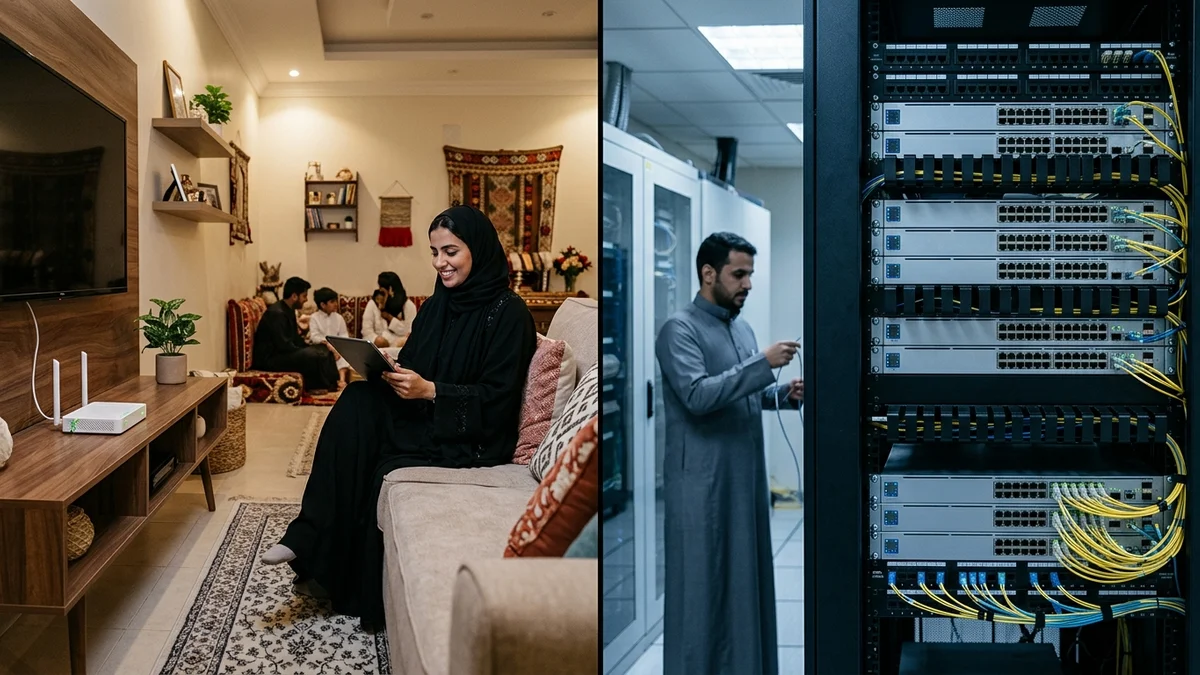
- Network Architecture Comparison: Shared Residential GPON vs. Business Broadband vs. Dedicated DIA
- Service Level Agreements (SLA) and Mean Time To Repair (MTTR): The True Cost of Downtime
- Static Public IPv4 Addresses vs. Residential CGNAT: Why Enterprise Firewalls Need Routed IPs
- ZATCA Tax Invoicing, Commercial Registration (CR), and Corporate Expense Compliance
- Decision Matrix: Which Fiber Tier Matches Your Work Setup and Address?
- Smart Continuity Architecture: Combining Primary Fiber with Automatic 5G Failover (Dual-WAN)
- Frequently Asked Questions About Residential vs. Business Fiber in Saudi Arabia
- Can I install a standard residential fiber package inside a commercial shop or company office?
- Is a 300 Mbps Business Fiber line faster than a 300 Mbps Residential Fiber line?
- Do I need Business Fiber or a Static IP to use my employer's corporate VPN when working from home?
- Why is Dedicated Internet Access (DIA) significantly more expensive than Business GPON Broadband?
- How can my company reclaim the 15% VAT paid on our monthly internet bills in Saudi Arabia?
If you work remotely from home, run a solo consulting practice, or manage an online business from a residential apartment or villa without hosting internal servers or site-to-site hardware firewalls, Residential Fiber (FTTH) is fully sufficient and delivers high-speed connectivity at the lowest monthly cost. However, if you operate a licensed commercial establishment (such as a company office, medical clinic, retail storefront, café, or warehouse) that requires a Static Public IPv4 address for firewalls, POS terminals, PBX phone systems, or IP whitelisting, demands a formal Service Level Agreement (SLA) with guaranteed repair windows, or needs a ZATCA-compliant B2B tax invoice bearing your Commercial Registration (CR) and 15% VAT number, then Business Fiber is an operational and regulatory necessity.
For many entrepreneurs, SME owners, and IT managers across Saudi Arabia, the distinction between home and commercial broadband can appear blurry because both services arrive over a thin glass optical fiber strand from the neighborhood cabinet. Yet the engineering and contractual reality behind the wall socket differs dramatically: residential and enterprise fiber diverge across optical splitter contention ratios, symmetrical upload provisioning, public IPv4 routing vs. CGNAT, Mean Time To Repair (MTTR) guarantees, and corporate tax compliance. This guide breaks down the exact technical, legal, and financial differences between Residential FTTH, Business GPON Broadband, and Dedicated Internet Access (DIA) in the Kingdom.

Network Architecture Comparison: Shared Residential GPON vs. Business Broadband vs. Dedicated DIA
To understand why residential and commercial fiber packages perform and price differently, we must examine the optical access architecture between your building and the telecom operator's central exchange. In Saudi Arabia, fiber optic internet is delivered through three distinct service tiers:
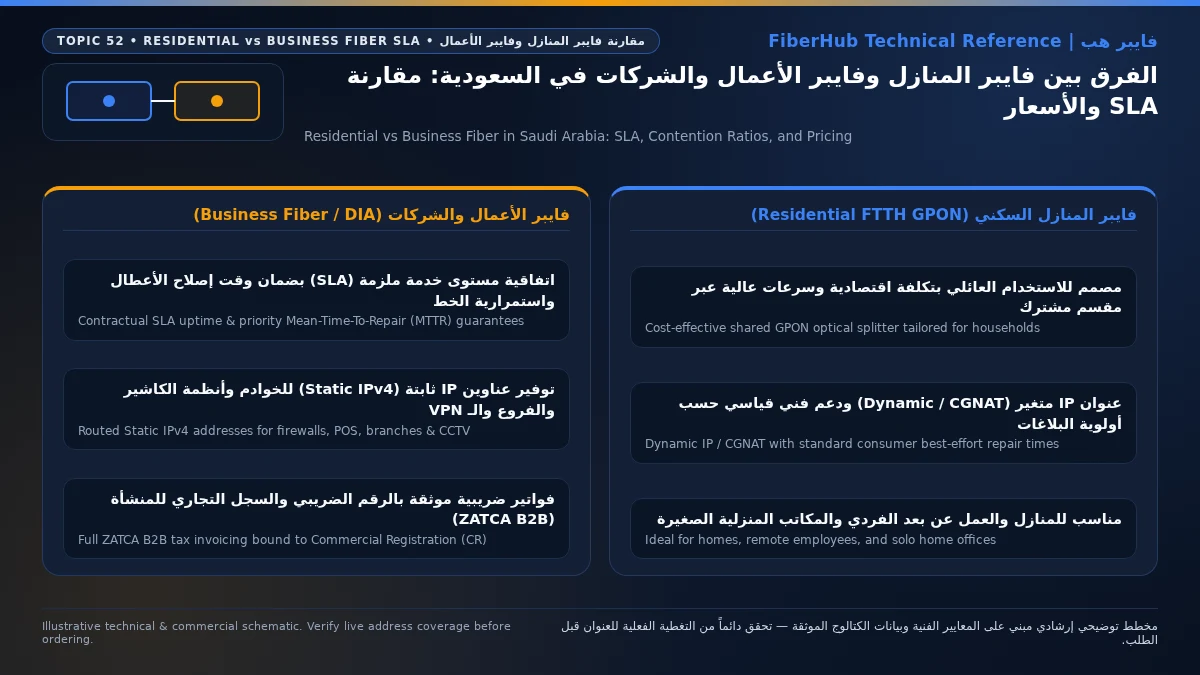
- Residential Shared FTTH (GPON / XGS-PON): Standard home fiber relies on Gigabit Passive Optical Network (GPON) architecture. A single fiber port on the provider's Optical Line Terminal (OLT) feeds an unpowered street cabinet splitter with a typical split ratio of 1:32 or 1:64. Consequently, your household shares the aggregate port capacity (2.488 Gbps downstream and 1.244 Gbps upstream on standard GPON) with 31 to 63 neighboring homes. While more than fast enough for household streaming and gaming, residential connections are provisioned on a Best-Effort basis without a contractually guaranteed minimum Committed Information Rate (CIR). Furthermore, upload speeds on many residential plans are asymmetrical, capped at roughly 20% to 25% of the headline download speed.
- Business Fiber Broadband (Business GPON): Engineered for small offices, retail shops, restaurants, pharmacies, and clinics (typically 3 to 25 employees), Business Broadband utilizes the same underlying GPON street access network but applies enterprise Quality of Service (QoS) traffic prioritization on the ISP backbone. Crucially, it unlocks one or more Static Public IPv4 addresses, business-grade CPE routing hardware, priority B2B technical support queues, and official corporate billing linked to your Commercial Registration.
- Dedicated Internet Access (DIA / Active Ethernet): Built for corporate headquarters, hospitals, hotels, financial institutions, and logistics hubs, DIA bypasses passive neighborhood splitters entirely. The telecom provider provisions a dedicated point-to-point active optical circuit directly from the core switch to an enterprise rack inside your server room with a 1:1 contention ratio (zero bandwidth sharing). A 200 Mbps DIA circuit delivers 200 Mbps download and 200 Mbps upload simultaneously (100% Symmetrical 1:1), backed by a 100% Committed Information Rate, a routed subnet of Static IPv4 addresses (/30 or /29), proactive 24/7 NOC monitoring, and a financially backed SLA.
The comparison matrix below summarizes the structural differences across Saudi Arabia's three fiber tiers:
| Technical & Contractual Dimension | Residential Fiber (Home FTTH) | Business Fiber Broadband (Business GPON) | Dedicated Internet Access (Enterprise DIA) |
|---|---|---|---|
| Optical Topology & Contention | Shared passive splitter (1:32 to 1:64) | Shared GPON with B2B QoS traffic priority | Dedicated 1:1 point-to-point uncontended fiber |
| Upload vs. Download Symmetry | Typically asymmetrical (Upload ~20%–25% of Down) | Asymmetrical or tier-dependent upload | Strictly 1:1 Symmetrical (Upload = Download) |
| Public IPv4 Addressing | Dynamic IP or shared ISP CGNAT | Includes 1 or more Static Public IPv4 addresses | Routed public IPv4 subnet (/30, /29, or larger) |
| SLA Uptime & Repair Window (MTTR) | Best-effort consumer repair (24–72 hours) | Priority business field dispatch (typically 8–24h) | Formal SLA (99.9%+) with 4-to-8-hour MTTR |
| ZATCA Tax Invoicing & CR Binding | B2C invoice under individual National ID/Iqama | B2B Tax Invoice with CR & 15% VAT number | Enterprise B2B Tax Invoice & Account Manager |
| Target Deployment Profile | Households, remote employees, solo home offices | Retail stores, clinics, SME offices (5–25 staff) | Corporate HQs, hotels, ERPs, multi-branch hubs |
Before signing a lease for a new office or upgrading your current connection, check our Saudi fiber coverage map to verify the optical infrastructure serving your specific building or commercial street.
Service Level Agreements (SLA) and Mean Time To Repair (MTTR): The True Cost of Downtime
When a residential fiber line goes offline on a Thursday evening due to a damaged street drop cable or a faulty ONT power supply, it is an inconvenience for the family, but household members can tether to mobile data until a technician visits within 24 to 72 hours. Residential subscriptions are governed by standard consumer protection frameworks overseen by the Communications, Space and Technology Commission (CST), which establish general service quality benchmarks for individual consumers.
In a commercial environment, however, internet downtime translates directly into lost revenue and halted operations. If a medical clinic cannot process insurance approvals on NPHIES, a busy café cannot synchronize cloud Point-of-Sale (POS) orders and delivery apps, or an accounting firm with 25 staff loses access to cloud ERP platforms for two business days, the financial loss dwarfs the monthly cost of the internet bill. This is where a Service Level Agreement (SLA) becomes critical:
- Contractual Mean Time To Repair (MTTR): Business Fiber and DIA contracts define a strict clock for fault resolution—typically 4 hours to 8 hours MTTR for dedicated circuits—operating 24 hours a day, 365 days a year, including Fridays, Saturdays, and national holidays. Field splicing and maintenance crews are dispatched on priority escalation paths.
- Proactive 24/7 NOC Telemetry: On enterprise DIA circuits, the provider's Network Operations Center (NOC) continuously monitors optical light levels (dBm) and CPE reachability via SNMP/ICMP. If a fiber cut occurs, a trouble ticket is often opened automatically before your IT team even places a call.
- Financial Service Credits: Formal SLAs guarantee monthly availability thresholds (such as 99.9% or 99.95% uptime). If the operator fails to meet the guaranteed restoration window, the business is contractually entitled to service credit rebates on its billing statement.
Static Public IPv4 Addresses vs. Residential CGNAT: Why Enterprise Firewalls Need Routed IPs
One of the sharpest technical boundaries between residential and business fiber lies in IPv4 addressing. To preserve scarce IPv4 address space, Saudi telecom operators place the vast majority of residential FTTH and 5G connections behind Carrier-Grade NAT (CGNAT) or assign dynamically rotating IP addresses. Behind CGNAT, your router shares a single public IPv4 address with dozens of other households. While outbound web browsing, video calls, and cloud apps work normally, inbound connections from the public internet cannot reach your router, and ISP-supplied residential ONT routers frequently lock down full transparent Bridge Mode.
Business Fiber packages eliminate CGNAT by assigning a dedicated Static Public IPv4 address (or a routed /30 or /29 subnet on dedicated tiers) and supporting clean Bridge Mode / IP Passthrough directly to your company's enterprise firewall (such as Fortinet FortiGate, Sophos, Cisco Meraki, or Ubiquiti UniFi Gateways). A Static IP is mandatory whenever your organization requires:
- Site-to-Site IPsec VPN Tunnels: Connecting branch offices, retail outlets, or warehouses in Jeddah, Riyadh, and Dammam back to a central headquarters firewall so internal subnets, inventory databases, and Active Directory domain controllers communicate over encrypted permanent tunnels without third-party relays.
- Remote Access VPN & Zero-Trust Gateways: Allowing traveling executives, external financial auditors, or remote staff to authenticate securely into the company's internal network via SSL, WireGuard, or IPsec VPN endpoints hosted on the office firewall.
- Strict IP Whitelisting for Banking, Government, and Cloud APIs: Corporate banking portals, payment gateways, healthcare insurance exchanges (such as NPHIES), cloud database clusters (AWS/Azure/GCP), and sensitive enterprise platforms often enforce firewall access control lists (ACLs) that only permit logins originating from your company's registered Static IP address.
- On-Premise IP PBX (SIP Trunks) and Multi-Site CCTV Aggregation: Binding voice-over-IP SIP trunks reliably without NAT registration drops, or streaming branch NVR security feeds into a central security operations center.
Furthermore, medium and large enterprises can request a routed IPv4 subnet: while a /30 allocation provides a single usable public IP for your primary firewall WAN interface, a /29 subnet delivers five usable public IPv4 addresses—allowing IT teams to assign separate dedicated IPs to active/passive High Availability (HA) firewalls, a dedicated SIP voice gateway, and a segregated DMZ reverse proxy.
Accurate comparison starts with what is available at your address
Not every operator serves every building box. Check coverage first to narrow your comparison to activatable plans.
ZATCA Tax Invoicing, Commercial Registration (CR), and Corporate Expense Compliance
Beyond routers and splitters, regulatory and accounting rules in Saudi Arabia dictate which broadband contract a business can legally claim. Residential fiber contracts are issued exclusively to natural persons (individuals) under a Saudi National ID or Resident Iqama number. The resulting monthly bill is a simplified consumer receipt (B2C) bearing an individual's name rather than a corporate legal entity.
Conversely, Business Fiber contracts are executed under your company's Commercial Registration (CR / السجل التجاري), National Address, and municipal license. Each month, the telecom provider issues a full B2B Tax Invoice (فاتورة ضريبية) compliant with the e-invoicing (Fatora) regulations enforced by the Zakat, Tax and Customs Authority (ZATCA). This invoice explicitly records your company's legal name, CR number, and 15-digit VAT Tax Identification Number alongside the 15% Value Added Tax (VAT) breakdown. Subscribing to an official business account enables your finance department to:
- Legally reclaim and deduct the 15% input VAT paid on telecom and internet services during quarterly or monthly ZATCA VAT filings.
- Record broadband expenditure as a verified corporate operating expense (OPEX) during annual financial audits and Zakat/tax assessments without compliance flags.
- Consolidate multiple branch lines under a unified corporate billing hierarchy payable via corporate SADAD business banking channels.
- Furthermore, commercial buildings, office towers, and street-front retail shops are classified as Commercial Plots in municipal and telecom GIS databases—meaning ISP ordering systems routinely block residential packages from being provisioned at commercial premises.
Decision Matrix: Which Fiber Tier Matches Your Work Setup and Address?
Use this practical engineering and commercial framework to select the right service without overspending:
- Scenario A: Remote Employees, Freelancers, and Home-Based Consultants: If you work from a study room inside your residential villa or apartment—using cloud suites (Microsoft 365, Google Workspace, Zoom, Teams) and connecting to your employer's network via a laptop VPN client—Residential FTTH (such as a 300 Mbps or 500 Mbps home fiber tier) is 100% sufficient. You do not need a Static IP or a commercial contract to join corporate VPNs or video calls. Explore residential fiber optic plans to pick a reliable high-speed home package.
- Scenario B: Licensed Retail Shops, Cafés, Medical Clinics, and Small Offices (3 to 25 Staff): If you operate from a commercial unit with POS payment terminals, cloud accounting, guest/staff Wi-Fi, and on-site security cameras—and you need a ZATCA tax invoice under your CR plus a Static IP for your office firewall or CCTV—choose Business Fiber Broadband (Business GPON). It delivers commercial compliance, Static IP routing, and priority business support at an accessible monthly fee.
- Scenario C: Medium-to-Large Enterprises, Headquarters, Hotels, and Warehouses (30+ Staff): When uninterrupted connectivity is mission-critical, dozens of employees upload large datasets simultaneously, or you host internal ERP/PBX infrastructure and SD-WAN hubs across multiple branches, invest in Dedicated Internet Access (DIA) with 1:1 symmetrical bandwidth and a binding 4-to-8-hour repair SLA.
Smart Continuity Architecture: Combining Primary Fiber with Automatic 5G Failover (Dual-WAN)
Many home-office professionals, financial traders, and small clinic owners ask: "Should I pay for an expensive dedicated enterprise circuit just to make sure my internet never drops during working hours?"
From a network reliability perspective, even an expensive single fiber line can go dark if a street excavator accidentally severs the underground duct outside your building. Instead of overpaying for enterprise DIA when you do not need dedicated 1:1 capacity, you can achieve 99.99% practical uptime at a fraction of the cost by implementing Dual-WAN Automatic Failover with carrier and physical path diversity:
- Connect your primary Fiber Optic (FTTH or Business GPON) line to WAN 1 on a Dual-WAN business gateway (such as a Ubiquiti UniFi Cloud Gateway, TP-Link Omada ER-series, or FortiGate firewall).
- Connect a 5G CPE Router—equipped with a data SIM from a different telecom operator than your fiber provider—into WAN 2 configured as an automatic failover backup.
- Configure automated WAN health checks (ICMP ping monitoring to external DNS servers every second). If the fiber connection drops for more than 3 seconds, the router seamlessly shifts all office or home-office traffic onto the 5G cellular link so POS terminals and video meetings stay alive, and automatically switches back once fiber service is restored. To compare providers and speeds for your primary and backup links, use our broadband comparison tool or review all available internet plans.
Frequently Asked Questions About Residential vs. Business Fiber in Saudi Arabia
Can I install a standard residential fiber package inside a commercial shop or company office?
In most cases, no. Telecom operators in Saudi Arabia classify buildings and fiber distribution boxes (FDBs) by municipal zoning as either residential or commercial. When you request service for a retail storefront or commercial office tower, the address is flagged in the ISP provisioning system as a commercial unit requiring a valid Commercial Registration (CR) and a Business Fiber plan. Additionally, residential terms of service restrict usage to personal household consumption and do not provide B2B tax invoices bearing your company's VAT number.
Compare total contract cost and 15% VAT side by side
Use our comparison view to inspect regular vs promotional pricing, upload speeds, and commitment months.
Is a 300 Mbps Business Fiber line faster than a 300 Mbps Residential Fiber line?
In terms of peak download speed during off-peak hours, 300 Mbps downloads data at the same rate on both lines. However, Business Fiber (and especially Dedicated DIA) outperforms residential lines in three crucial areas: sustained peak-hour throughput due to lower contention ratios (or 1:1 dedicated capacity on DIA), symmetrical upload speeds (where a 300 Mbps DIA line provides a full 300 Mbps upload compared to 60–75 Mbps on many residential tiers), and higher backbone QoS routing priority for low-latency enterprise voice and cloud traffic.
Do I need Business Fiber or a Static IP to use my employer's corporate VPN when working from home?
No. When you work from home and connect to your company's network using software like Cisco AnyConnect, Palo Alto GlobalProtect, FortiClient, or Microsoft Always On VPN, your laptop acts as an outbound VPN client. Outbound VPN connections work flawlessly over standard Residential Fiber even behind dynamic IPs or CGNAT. A Static IP and Business Fiber are only required at the corporate office that hosts the incoming VPN server gateway.
Why is Dedicated Internet Access (DIA) significantly more expensive than Business GPON Broadband?
Business GPON Broadband shares the neighborhood passive optical splitter with other nearby users and provides best-effort or prioritized bandwidth. Dedicated Internet Access (DIA), by contrast, provisions a private, unshared 1:1 optical fiber circuit from the telecom exchange directly to your premises, guarantees 100% of your subscribed download and upload speed 24/7, includes a routed block of Static IPv4 addresses, and backs the circuit with a 24/7 formal SLA and 4-to-8-hour field repair guarantees.
How can my company reclaim the 15% VAT paid on our monthly internet bills in Saudi Arabia?
To deduct the 15% input Value Added Tax (VAT) on your periodic ZATCA tax return, your broadband subscription must be registered under your company's legal name, Commercial Registration (CR), and 15-digit VAT Tax Identification Number so the ISP issues an official ZATCA-compliant B2B Tax Invoice. Consumer bills issued under an individual's National ID or Iqama for residential internet cannot be used by a corporate entity to reclaim input VAT.
Select the right plan after verifying coverage and terms
Open the interactive plan comparison or submit a coverage check to match a plan to your household budget.
Editorial Transparency & Neutrality Notice:
This guide is provided for comparison and decision support. It does not constitute final address coverage confirmation, binding operator pricing, or regulatory accreditation. Always verify final plan terms and box readiness before completing your subscription request.