- How Open Access Works Under the Hood: Wholesale Plant (WSP) vs Retail ISP (RSP)
- The Building Plate Matrix: Decoding the Metal Tag on Your Exterior Wall
- Why Open Access Orders Are Occasionally Declined: 4 Real-World Engineering Constraints
- The Financial Power of Open Access: Comparing Verified 2026 Plans on the Same Fiber Box
- Urban Topologies: How Open Access Provisioning Differs Between Villas, Apartments, and Dawiyat Zones
- Step-by-Step Ordering Guide: How to Provision an Open Access Fiber Line
- Who Fixes Physical Line Faults on an Open Access Connection? (Single Point of Contact Rule)
- Frequently Asked Questions About CST Open Access Broadband in Saudi Arabia
- Is an Open Access fiber connection slower or higher latency than subscribing directly to the box owner?
- Do I pay any extra wholesale surcharge on my monthly bill when using Open Access?
- How can I tell if my building's fiber box is owned by Dawiyat, stc, Mobily, or Salam?
- Can I switch from my current fiber provider to a cheaper operator on the same wall box without digging?
- Does Open Access support both postpaid and prepaid fiber plans in Saudi Arabia?
Yes, in most fiber-connected residential districts across Saudi Arabia, you can subscribe to a retail internet service provider (ISP) different from the telecom operator whose logo is stamped on your building's exterior Optical Distribution Box (ODB), thanks to the landmark Open Access Broadband Regulation enforced by the Communications, Space and Technology Commission (CST). However, Open Access provisioning is conditional on active wholesale interconnect coverage in your district and spare splitter port availability inside your building's fiber cabinet; the regulatory framework decouples the Wholesale Service Provider (WSP) that owns the physical glass fiber in the street from the Retail Service Provider (RSP) that bills your account, supplies your Wi-Fi 6 Gigabit Router, and routes your internet traffic.
Prior to the rollout of the CST Open Access mandate, Saudi residential broadband operated under last-mile geographic exclusivity: whichever operator trenched the street and bolted an optical cabinet onto your villa or apartment building became your sole fixed-line option. Today, passive optical networks across Riyadh, Jeddah, Dammam, Khobar, Makkah, Madinah, and regional cities function as shared national infrastructure across participating entities—stc, Mobily, Zain, Salam (Integrated Telecom), and Dawiyat Integrated (a subsidiary of the Saudi Electricity Company). This authoritative technical and regulatory guide explains how wholesale optical handoffs work under the hood, why certain buildings face port or scope restrictions, and how to use Open Access to slash your monthly broadband bill in 2026.

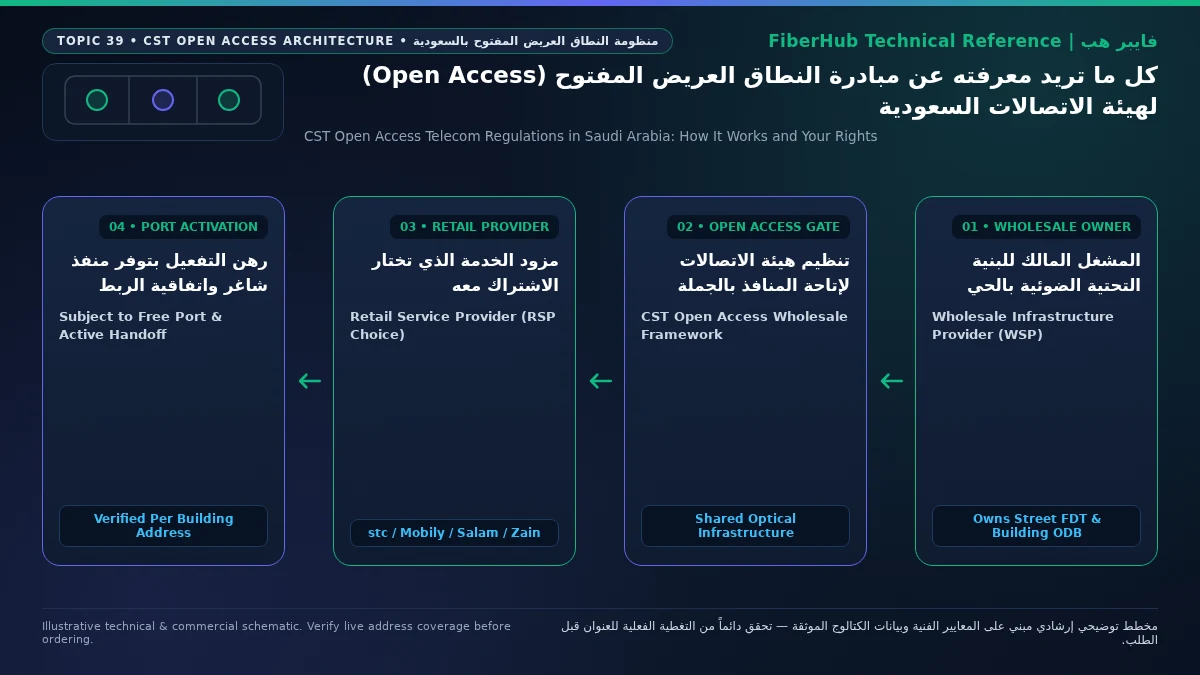
How Open Access Works Under the Hood: Wholesale Plant (WSP) vs Retail ISP (RSP)
To understand how a Salam Fiber or Zain Fiber subscription can run seamlessly over a physical optical cable trenched by stc, Mobily, or Dawiyat without speed degradation, it helps to examine how modern ITU-T G.984 GPON and G.9807 XGS-PON networks separate physical transport from logical internet service:
- The Wholesale Service Provider (WSP — Physical Access Layer): The WSP is the infrastructure owner that excavated the street duct, pulled the underground optical feeder cables, mounted the weatherproof Optical Distribution Box (ODB) on your building perimeter, and operates the neighborhood Optical Line Terminal (OLT). The WSP maintains the physical laser budget (ensuring optical receive power stays within
-15 dBmto-24 dBm) and provisions a dedicated Layer-2 virtual bitstream channel (VLAN) from your home ONT to the regional interconnect handover point. - The Retail Service Provider (RSP — Logical IP & Customer Layer): The RSP is the retail brand you select and sign a contract with (
stc,Mobily,Zain, orSalam). Once the WSP hands off your Layer-2 bitstream at the regional Point of Interconnect (POI), your chosen RSP handlesPPPoE/DHCPauthentication, assigns your public IPv4/IPv6 addresses, supplies your serializedWi-Fi 6 Gigabit Router, routes your packets across its own domestic peering and international submarine cables, and manages your monthly billing.
This architectural separation carries a profound implication for gamers, remote workers, and families: while the glass fiber on your street wall is physically identical, your monthly price, upload tier, international gaming latency (Ping), and customer care experience are determined by the Retail ISP (RSP) you choose—not the logo stamped on the wall plate! You can verify which retail providers can provision your building's cabinet today using the FiberHub Address & Open Access Coverage Checker.
The Building Plate Matrix: Decoding the Metal Tag on Your Exterior Wall
When you inspect the gray fiberglass or metal enclosure mounted on your villa fence or apartment telecom riser, the embossed metallic plate identifies the Wholesale Service Provider (WSP). The matrix below outlines how each infrastructure owner integrates into the Saudi Open Access ecosystem:
| Exterior ODB Plate Logo (Wholesale Owner — WSP) | Network Operating Model | Eligible Retail Service Providers (RSPs) Subject to District Interconnect & Spare Ports | How Field Installation & ONT Activation Are Executed |
|---|---|---|---|
| Dawiyat Integrated (ضوئيات المتكاملة) | Pure-Play Neutral Wholesale Operator (does not sell direct retail plans to consumers) | stc, Mobily, Zain, and Salam (all four major retail ISPs sell their catalog plans over Dawiyat fiber). | Dawiyat field technician patches the ODB splitter and verifies the ONT optical link; the retail ISP delivers/activates the Wi-Fi 6 router. |
| stc Fiber Plate | Integrated Operator (Wholesale + Retail) | Direct on-net subscription with stc, or off-net Open Access subscription via Mobily, Zain, or Salam in enabled exchanges. | Direct stc technician for on-net orders, or coordinated WSP/RSP wholesale provisioning workflow for Open Access orders. |
| Mobily Fiber Plate | Integrated Operator (Wholesale + Retail) | Direct on-net subscription with Mobily, or off-net Open Access subscription via stc, Zain, or Salam in enabled exchanges. | Mobily technician for direct lines, or inter-operator wholesale activation workflow for partner ISP orders. |
| Salam / ITC Fiber Plate | Integrated Operator (Wholesale + Retail) | Direct on-net subscription with Salam, or off-net Open Access subscription via participating retail partners. | Salam field engineering crew or coordinated wholesale handoff team. |
Why Open Access Orders Are Occasionally Declined: 4 Real-World Engineering Constraints
Consumers are sometimes puzzled when they see a physical fiber box bolted to their apartment wall, yet an online order with an alternative ISP returns an "Unserviceable / Port Unavailable" status. Open Access is governed by four practical technical and operational constraints:
- ODB Optical Splitter Port Exhaustion: Every building distribution box houses a passive optical splitter with a fixed physical port count (typically 8 ports for villas or 16 to 32 ports for multi-dwelling apartment buildings). If every single optical port in that splitter is already occupied by active neighbor subscriptions, neither the infrastructure owner nor any Open Access partner can activate a new line until field engineering installs an expansion splitter.
- Phased Exchange Onboarding in Newly Built Districts: When a wholesale operator finishes trenching a brand-new subdivision, there is a technical commissioning window before the local OLT is fully integrated into the inter-operator B2B wholesale ordering gateway. During this initial commissioning window, only direct on-net orders may process until wholesale virtual circuits are live.
- Orphaned Active Sessions or Duplicate Pending Orders: Only one active bitstream session can occupy a single residential drop fiber unless a secondary port is assigned. If a previous tenant vacated the apartment without terminating their fiber line, or if you submit two simultaneous orders with two different ISPs on the same day, the automated wholesale clearinghouse will lock the port due to a reservation conflict. Always clear pending orders before switching.
- Product-Specific Hardware Boundaries (Standard FTTH vs FTTR): Standard residential broadband tiers (100 Mbps, 200 Mbps, 300 Mbps, 500 Mbps, and 1000 Mbps) are designed for seamless wholesale bitstream handoff. However, specialized room-level optical mesh products—such as
STC Baity Fiber Plus FTTR(488.75 SAR/month),Mobily Home FTTR 500 Mbps(460 SAR/month), orSalam Home FTTR 500(402.5 SAR/month)—rely on proprietary master/slave optical transceivers managed directly by the retail operator's ACS server and may have specific eligibility rules.
The Financial Power of Open Access: Comparing Verified 2026 Plans on the Same Fiber Box
The biggest practical benefit of the CST Open Access framework is price and feature competition at your doorstep. Instead of accepting a single operator's tariff, a single ODB on your wall lets you shop across all four licensed catalogs. Every price in the table below comes directly from the verified 2026 Saudi catalog, includes 15% VAT in compliance with ZATCA regulations, includes a Wi-Fi 6 Gigabit Router, and enforces zero Fair Usage Policy (has_fup: false):
| Speed Tier Category | stc Verified Catalog Option (15% VAT Inc.) | Mobily Verified Catalog Option (15% VAT Inc.) | Zain Verified Catalog Option (15% VAT Inc.) | Salam Verified Catalog Option (15% VAT Inc.) | Strategic Advantage of Shopping via Open Access |
|---|---|---|---|---|---|
| 300 Mbps Download / 100 Mbps Upload | STC Baity Fiber Basic: 287.5 SAR/mo (12m) or STC Baity Fiber 300: 345 SAR/mo (12m) |
Mobily Fiber Postpaid 300: 345 SAR/mo (12m) or Prepaid 300: 287.5 SAR/mo (1m commitment) |
Zain Fiber Home Plus (300 Mbps): 279 SAR/mo (18m) or Zain Fiber 300: 287.5 SAR/mo (12m) |
Salam Fiber 300: 287.5 SAR/mo (12m postpaid or 6m prepaid) |
Lets you pick a 279 SAR or 287.5 SAR plan instead of paying 345 SAR/mo—saving up to 690 SAR/year on the exact same 300/100 Mbps speed! |
| 500 Mbps Download Tier (Standard & Gaming) | STC Baity Fiber Stream: 402.5 SAR/mo (500/125 Mbps, 12m) or Baity Fiber 500: 460 SAR/mo |
Mobily Fiber Gamers: 402.5 SAR/mo (500/150 Mbps, 12m) or Postpaid 500: 460 SAR/mo |
Zain Fiber Home Premium: 389 SAR/mo (500/200 Mbps, 18m) |
Salam Fiber 500: 345 SAR/mo (500/125 Mbps, 12m) or Salam Fiber Gaming: 399 SAR/mo (500/200 Mbps) |
Lets you get 500 Mbps on Salam for 345 SAR/mo (the price others charge for 300 Mbps!) or choose a 200 Mbps upload tier for gaming and content creation. |
| 1000 Mbps (1 Gbps Download / 300 Mbps Upload) | STC Baity Fiber Max (1 Gbps): 920 SAR/mo (12m commitment) |
Mobily Fiber Postpaid 1GB: 920 SAR/mo (12m) or Prepaid 1GB: 920 SAR/mo (1m) |
Zain Fiber Home Black (1 Gbps): 949 SAR/mo (18m commitment) |
Salam Fiber 1000 (Gigabit): 460 SAR/mo (12m postpaid or 6m prepaid) |
Massive 50% cost reduction in the Gigabit tier: Salam delivers 1000/300 Mbps at 460 SAR/mo compared to 920–949 SAR/mo elsewhere! |
You can compare all active packages side by side and filter by contract length or upload speed on the FiberHub Broadband Comparison Tool.
Verify fiber box readiness at your address first
Fiber availability depends on your building ODB plate and port status. Check your address to see eligible operators.
Urban Topologies: How Open Access Provisioning Differs Between Villas, Apartments, and Dawiyat Zones
Field provisioning workflows under the Saudi Open Access framework vary depending on the physical architecture of your residential neighborhood:
- Dawiyat Integrated Wholesale Zones: Across major expansion districts in Riyadh, Jeddah, Greater Dammam, Qassim, Madinah, Abha, and Tabuk where fiber was deployed alongside Saudi Electricity Company smart meter corridors by Dawiyat Integrated, the optical network was engineered from day one as a neutral wholesale platform. Because Dawiyat does not compete for retail residential subscribers, ordering
stc,Mobily,Zain, orSalamover a Dawiyat wall plate follows a highly standardized B2B automated dispatch process. - Standalone Villas and Duplexes with Exterior Boundary ODBs: In villa neighborhoods, the 8-port Optical Distribution Box is mounted on the exterior street wall, accessible 24/7 to wholesale field crews without requiring building management keys. As a result, inter-operator port patching on villa boxes typically completes within 2 to 4 business days.
- Multi-Dwelling Apartment Buildings (MDUs) and Gated Compounds: In apartment buildings containing 16 to 32 flats, the primary fiber distribution cabinet is usually housed inside a locked ground-floor electrical room or basement riser. When placing an Open Access order for an apartment unit, ensure the building caretaker (
Haris) or homeowners' association (Mullak) grants access to the telecom room on the scheduled installation day so the wholesale technician does not close the ticket as Customer Site Inaccessible.
Step-by-Step Ordering Guide: How to Provision an Open Access Fiber Line
To ensure your Open Access order progresses smoothly from online submission to live optical light without administrative delays, follow this four-step operational sequence:
- Capture Your Building ODB Plate & SPL National Address: Take a sharp photo of your building's exterior fiber distribution box plate (recording both the WSP logo and the alphanumeric cabinet code) alongside your four-digit National Address building number and postal code.
- Select Your Retail Plan From the Verified Fiber Catalog: Review the Saudi Fiber Broadband Plans Directory and pick the retail ISP and tariff that match your budget and commitment preference (1-month prepaid, 6-month prepaid, 12-month postpaid, or 18-month postpaid).
- Coordinate the Wholesale/Retail Field Appointment: Once your order is logged in the national Open Access clearinghouse, the field activation is scheduled. Depending on the infrastructure owner, either a unified technician or a coordinated WSP optical splicer + RSP router installer will patch your building port, verify the ONT optical power (
-15 dBmto-24 dBm), and connect yourWi-Fi 6 Gigabit Router. - Validate Throughput & Meqyas Latency Benchmarks: Before signing off on the installation ticket, run a wired Cat6 Ethernet test to confirm your full provisioned download and upload speeds and verify low-latency routing aligned with CST
Meqyasquality benchmarks.
Who Fixes Physical Line Faults on an Open Access Connection? (Single Point of Contact Rule)
A common concern among homeowners ordering across networks is: "If a street excavator cuts a Mobily or Dawiyat fiber cable outside my villa, but my monthly subscription is with stc or Salam, will the two companies blame each other and leave me offline?"
CST Open Access regulations strictly prohibit inter-operator finger-pointing through the Single Point of Contact (SPOC) Consumer Mandate:
- Your Retail ISP (RSP) Owns Full Customer Accountability: You never contact the wholesale infrastructure owner directly for support, billing, or fault repair. Your retail provider is legally responsible for receiving your trouble ticket, diagnosing the fault remotely, and managing the resolution end to end.
- Binding Wholesale SLA Repair Windows: If remote diagnostics show that the optical signal at your ONT has dropped (
LOSred light) due to an exterior splitter or underground cable fault, your retail ISP automatically dispatches a binding B2B wholesale repair order to the WSP under regulated CST Service Level Agreement (SLA) timers. If repair timers are breached, your retail ISP remains accountable to you for regulatory service credits.
Frequently Asked Questions About CST Open Access Broadband in Saudi Arabia
Is an Open Access fiber connection slower or higher latency than subscribing directly to the box owner?
No. Your provisioned download and upload bandwidth (e.g., 300/100 Mbps or 500/125 Mbps) is identical whether you subscribe directly to the infrastructure owner or through an Open Access retail ISP. Furthermore, because internet routing and international peering are handled by your chosen retail ISP's core network, switching to an ISP with optimized gaming routes (such as Mobily Fiber Gamers at 402.5 SAR or Salam Fiber Gaming at 399 SAR) can actually improve your in-game latency even over another operator's physical street box.
Match fiber speed and upload tiers to your household
Review published FTTH plans and compare download/upload speeds, commitment terms, and hardware conditions.
Do I pay any extra wholesale surcharge on my monthly bill when using Open Access?
No. Retail tariffs under CST Open Access are uniform; you pay the exact same published VAT-inclusive monthly price (for example, 287.5 SAR/month for a 300 Mbps tier) regardless of whether your building's fiber box belongs to your chosen ISP, Dawiyat, or another operator. Wholesale port rental fees are settled strictly between the operators behind the scenes.
How can I tell if my building's fiber box is owned by Dawiyat, stc, Mobily, or Salam?
Check the stamped metal identification plate riveted to the gray or metallic Optical Distribution Box (ODB) on your exterior boundary wall or ground-floor utility room. The plate clearly displays the infrastructure owner's emblem (Dawiyat ضوئيات, stc, Mobily, Salam, or Zain) along with the cabinet serial code required by technicians during provisioning.
Can I switch from my current fiber provider to a cheaper operator on the same wall box without digging?
Yes. Once your current 12-month or 18-month contract commitment finishes, you can order a plan from a competing retail ISP over the exact same passive optical drop cable entering your home. The wholesale port assignment is updated electronically and your indoor router is swapped to the new provider's Wi-Fi 6 Gigabit Router without any street excavation or wall drilling.
Does Open Access support both postpaid and prepaid fiber plans in Saudi Arabia?
Eligibility for specific postpaid or prepaid tiers depends on the retail operator's commercial catalog enabled for that exchange. In most active Open Access districts, you can order standard 12-month or 18-month postpaid packages as well as eligible prepaid fiber packages (such as 300, 500, or 1000 Mbps tiers), which you can verify instantly using the address coverage checker.
Regulatory & Technical Sources: Communications, Space and Technology Commission (CST) Wholesale Open Access and Interconnection Regulatory Framework, CST Meqyas National Broadband Quality Reports, ZATCA 15% VAT Retail Tariff Rules, and verified 2026 broadband disclosures from stc, Mobily, Zain, Salam, and Dawiyat Integrated.
Ready to verify coverage and request home fiber?
Submit your address or ODB plate details so we can confirm availability and walk you through eligible plans.
Editorial Transparency & Neutrality Notice:
This guide is provided for comparison and decision support. It does not constitute final address coverage confirmation, binding operator pricing, or regulatory accreditation. Always verify final plan terms and box readiness before completing your subscription request.