
- What Is a Fair Usage Policy (FUP) Technically, and Why Do Optical Fiber Networks Never Need It?
- CST Regulatory Protections: Banning Misleading "Unlimited" Claims in KSA
- Verified 2026 Catalog Audit: Confirming `hasfup: false` Across Saudi Fiber & Home 5G Plans
- If My Plan Has Zero FUP, Why Does My Speed Drop at 9:00 PM? (4 Technical Culprits)
- 3-Step Diagnostic Test: How to Prove Whether Your Line Is Throttled or Congested
- How Much Data Does a Modern Saudi Household Actually Consume Per Month?
- Do Prepaid Fiber & Home 5G Plans Have FUP Caps Compared to Postpaid Contracts?
- Frequently Asked Questions About Fair Usage Policy (FUP) in Saudi Arabia
- Do stc, Mobily, Zain, or Salam apply a Fair Usage Policy (FUP) on home fiber plans?
- Are fixed Home 5G plans in Saudi Arabia truly unlimited without FUP caps?
- Which internet SIM cards in Saudi Arabia might still have data caps or FUP rules?
- Can an ISP disconnect my unlimited home internet if I download several terabytes a month?
- How can I verify that a broadband plan has zero FUP before I sign the contract?
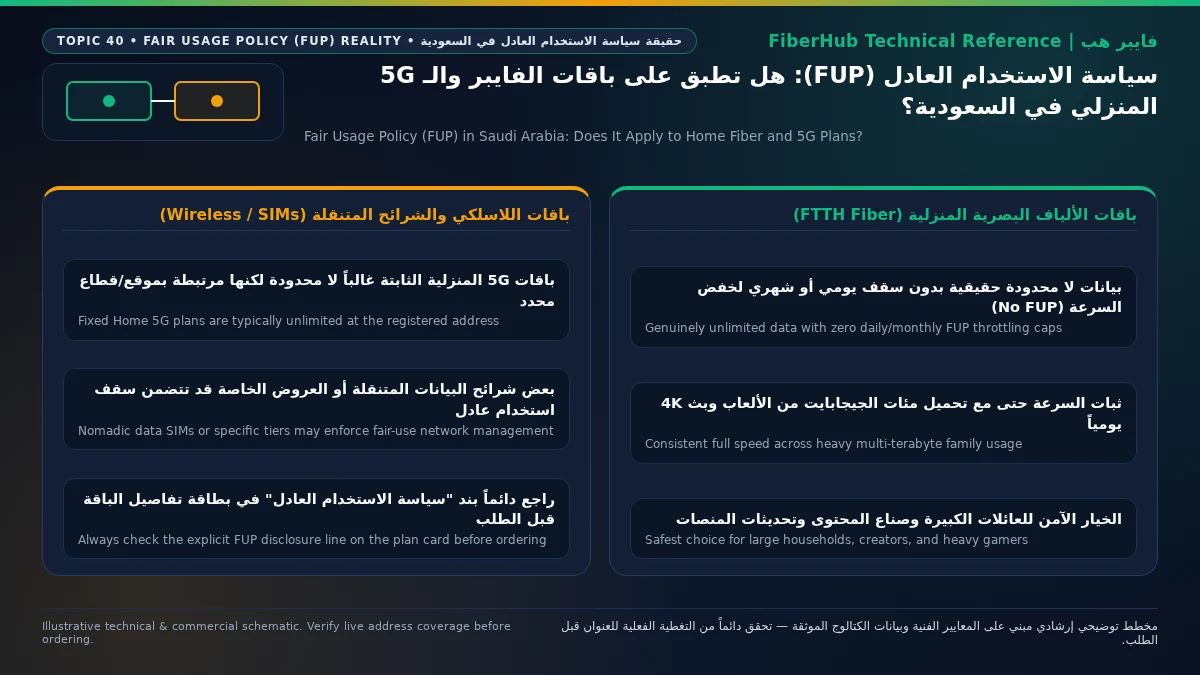
Yes, your home internet is genuinely unlimited: every residential Fiber-to-the-Home (FTTH) package and fixed Home 5G broadband plan marketed as unlimited in the verified 2026 Saudi catalog across stc, Mobily, Zain, and Salam operates with zero Fair Usage Policy throttling (has_fup: false). Consumer transparency regulations enforced by the Communications, Space and Technology Commission (CST) strictly prohibit licensed telecom operators in Saudi Arabia from advertising any broadband package as "Unlimited" if it conceals a daily or monthly data cap that throttles user bandwidth. However, consumers must still inspect the official Tariff Disclosure Card before ordering to distinguish true residential fixed broadband plans (has_fup: false) from nomadic mobile data SIMs or international roaming add-ons that carry explicit gigabyte allowances.
For years, broadband shoppers across the Middle East remained skeptical of the word "Unlimited" due to legacy cellular policies from the 3G and early 4G era, when consuming more than a few gigabytes in a single afternoon triggered an automatic speed drop to 512 Kbps or 2 Mbps. In Saudi Arabia's modern regulatory and infrastructure environment, CST enforcement combined with nationwide GPON/XGS-PON optical fiber and high-capacity 3.5 GHz 5G deployments has eliminated hidden FUP traps from residential home broadband. This technical and legal guide explains why fixed optical fiber never requires volume caps, how fixed Home 5G manages tower capacity without FUP throttling, and how to diagnose evening slowdowns that users often mistake for artificial throttling.

What Is a Fair Usage Policy (FUP) Technically, and Why Do Optical Fiber Networks Never Need It?
A Fair Usage Policy (FUP) is a programmable traffic-policing rule configured inside an operator's Broadband Network Gateway (BNG) or Policy and Charging Rules Function (PCRF). When an FUP rule is active on a subscription profile, the billing counter tracks cumulative downloaded and uploaded bytes over a rolling 24-hour, 7-day, or 30-day window. If the subscriber crosses a predefined threshold, the network does not disconnect the session; instead, it rewrites the subscriber's QoS rate limit to a fraction of the headline speed until the counter resets.
Understanding why residential FTTH fiber in Saudi Arabia has zero need for FUP requires comparing the physical layer of optical glass against shared radio waves:
- Passive Optical Networks (
ITU-T G.984 GPON&G.9807 XGS-PON): In a residential fiber network, data travels as modulated laser light over single-mode glass strands with multi-gigabit wavelength capacity. Even though an exterior Optical Distribution Box (ODB) splits a fiber feeder among neighboring villas or apartments, the optical line terminal (OLT) backhaul and core aggregation switches are engineered with massive non-blocking throughput. Whether your family downloads 500 GB or 8 TB of 4K streams and PlayStation updates in a month, your laser time-division multiplexing (TDM) slots do not starve your neighbor's connection. - Shared Cellular Radio Spectrum (
3GPP 5G NR n78): In wireless broadband, every smartphone, tablet, and home 5G router connected to a neighborhood cell tower sector shares a finite block of radio frequency spectrum (typically 100 MHz ofn78TDD spectrum) and a fixed pool of Physical Resource Blocks (PRBs). In the legacy 4G era, limited tower capacity forced operators to impose daily FUP caps. Today, thanks to64T64R Massive MIMOantennas and fiber-fed 5G macro towers, Saudi operators offer fixed residential 5G plans withhas_fup: false—managing tower load by binding fixed Home 5G SIMs to a registered residential address rather than imposing gigabyte caps.
CST Regulatory Protections: Banning Misleading "Unlimited" Claims in KSA
The Communications, Space and Technology Commission (CST) established strict truth-in-advertising rules under its Telecommunications and Information Technology User Rights Protection Regulations:
- Truthful "Unlimited" Labeling: Licensed service providers are barred from marketing or labeling any internet tariff as "Unlimited" (غير محدود) if the package applies a Fair Usage Policy cap, volume quota, or automatic speed reduction after a certain data threshold.
- Mandatory Tariff Disclosure Cards: Every retail broadband plan must publish a standardized Tariff Disclosure Card prior to contract signature. If a plan is genuinely unlimited, the disclosure card explicitly records No Fair Usage Policy (
has_fup: false). Conversely, if a mobile data or roaming product has a finite data cap followed by reduced speed, the exact gigabyte threshold and post-cap speed must be disclosed upfront. - Consumer Remedy for Undeclared Throttling: If a subscriber signs a contract whose disclosure card states zero FUP (
has_fup: false) and proves that their connection is being artificially volume-throttled, CST regulations entitle the subscriber to escalate a formal dispute and terminate the contract without early termination penalties.
You can inspect and compare verified contract terms across all licensed providers on the FiberHub Broadband Comparison Tool.
Verified 2026 Catalog Audit: Confirming has_fup: false Across Saudi Fiber & Home 5G Plans
The reference table below audits flagship residential FTTH fiber and fixed Home 5G packages from the verified 2026 Saudi catalog across stc, Mobily, Zain, and Salam (all monthly prices include 15% VAT in accordance with ZATCA regulations):
| Verified Catalog Plan Name & Slug | Provider & Access Tech | Download / Upload Speed | Monthly Price (15% VAT Inc.) | Fair Usage Policy (has_fup) |
Monthly Data Volume Allowance |
|---|---|---|---|---|---|
STC Baity Fiber Basic (300 Mbps) (stc-baity-fiber-basic) |
stc — FTTH Optical Fiber | 300 / 100 Mbps | 287.5 SAR | None (false) |
100% Unlimited (Zero daily or monthly cap) |
STC Baity Fiber Stream (500 Mbps) (stc-baity-fiber-stream) |
stc — FTTH Optical Fiber | 500 / 125 Mbps | 402.5 SAR | None (false) |
100% Unlimited (Zero daily or monthly cap) |
Mobily Fiber Postpaid 300 (mobily-fiber-postpaid-300) |
Mobily — FTTH Optical Fiber | 300 / 100 Mbps | 345 SAR | None (false) |
100% Unlimited (Zero daily or monthly cap) |
Mobily Fiber Gamers (mobily-fiber-gamers) |
Mobily — FTTH Optical Fiber | 500 / 150 Mbps | 402.5 SAR | None (false) |
100% Unlimited (Zero daily or monthly cap) |
Zain Fiber Home Plus (300 Mbps) (zain-fiber-home-plus) |
Zain — FTTH Optical Fiber | 300 / 100 Mbps | 279 SAR | None (false) |
100% Unlimited (Zero daily or monthly cap) |
Zain Fiber Home Premium (500 Mbps) (zain-fiber-home-premium) |
Zain — FTTH Optical Fiber | 500 / 200 Mbps | 389 SAR | None (false) |
100% Unlimited (Zero daily or monthly cap) |
Salam Fiber 500 (salam-fiber-500) |
Salam — FTTH Optical Fiber | 500 / 125 Mbps | 345 SAR | None (false) |
100% Unlimited (Zero daily or monthly cap) |
Salam Fiber 1000 (Gigabit) (salam-fiber-1000) |
Salam — FTTH Optical Fiber | 1000 / 300 Mbps | 460 SAR | None (false) |
100% Unlimited (Zero daily or monthly cap) |
STC Baity 5G Home Wireless Unlimited (stc-5g-home) |
stc — Fixed Home 5G | 300 / 50 Mbps | 287.5 SAR | None (false) |
100% Unlimited at registered home location |
Mobily Home 5G Unlimited (mobily-home-5g-unlimited) |
Mobily — Fixed Home 5G | 500 / 100 Mbps | 402.5 SAR | None (false) |
100% Unlimited (Zero FUP throttling) |
Zain 5G Max Home (zain-5g-max) |
Zain — Fixed Home 5G | 1000 / 200 Mbps | 299 SAR | None (false) |
100% Unlimited (Zero FUP throttling) |
Salam HomeFi Max 5G (salam-homefi-max) |
Salam — Fixed Home 5G | 500 / 100 Mbps | 345 SAR | None (false) |
100% Unlimited (Zero FUP throttling) |
You can explore the complete lineup of verified zero-FUP packages in our Saudi Fiber Broadband Directory and Saudi Home 5G Plans Guide.
If My Plan Has Zero FUP, Why Does My Speed Drop at 9:00 PM? (4 Technical Culprits)
A frequent question from subscribers on unlimited plans is: "If my contract has has_fup: false, why does my download speed dip between 8:30 PM and 11:30 PM or when downloading a massive game patch? Isn't my ISP throttling me?"
In almost every residential diagnostic case, evening slowdowns on zero-FUP plans are caused by one of four physical or network bottlenecks unrelated to Fair Usage Policies:
- Peak-Hour Radio Sector Contention on Home 5G (
PRBSharing): If you use a Fixed Wireless Home 5G router, your connection shares the local cell tower's radio scheduler with hundreds of neighbors. At 6:00 AM, when the cell sector is idle, a 500 Mbps 5G plan easily hits 450–500 Mbps. At 9:30 PM, when dozens of households stream live football in 4K simultaneously, the tower proportionally divides available radio time slots among active users, causing throughput to fluctuate between 120 Mbps and 220 Mbps—before rebounding automatically late at night. By contrast, true FUP throttling locks your speed at a flat, rigid ceiling (e.g., exactly 2.0 Mbps) even at 4:00 AM when the tower is empty! - Indoor Wi-Fi Interference and 5G Router Thermal Throttling: When a 5G CPE or Wi-Fi router downloads continuously for hours in a warm room or on a sunlit windowsill, internal baseband temperatures can exceed 75°C, prompting the chipset to throttle clock speeds to prevent hardware damage. Similarly, evening congestion on crowded
2.4 GHzWi-Fi channels in apartment buildings degrades wireless speeds while wired Ethernet remains at 100% capacity. - Upstream Game Server and CDN Rate Limiting: When millions of players download a 140 GB
Call of DutyorEA Sports FCupdate simultaneously, content delivery networks (PlayStation Network, Xbox Live, Steam) cap per-connection transfer rates on their servers. Running a concurrent test on CST'sMeqyasserver over wired Ethernet will show your ISP line still has full unused bandwidth. - Misconfigured Router QoS or Old Ethernet Cables (
Cat5100 Mbps Limit): A damaged Ethernet cable with a broken wire pair automatically negotiates down from1000BASE-T(1 Gbps) to100BASE-TX(100 Mbps), capping any 300 or 500 Mbps plan at ~94 Mbps until the cable is replaced.
Verify fiber box readiness at your address first
Fiber availability depends on your building ODB plate and port status. Check your address to see eligible operators.
3-Step Diagnostic Test: How to Prove Whether Your Line Is Throttled or Congested
You can distinguish true FUP rate limiting from local Wi-Fi or cell-sector contention in under five minutes using this repeatable engineering test:
- Step 1 — Isolate the Wired Interface: Disconnect background wireless devices temporarily and connect a laptop directly to your ONT/router's
Gigabit LAN 1port using a certifiedCat6patch cable. - Step 2 — Run CST Meqyas Off-Peak vs Peak Benchmarks: Execute a speed test on the official CST
Meqyasplatform at 9:30 PM (peak hour) and again at 7:00 AM (off-peak). On FTTH optical fiber, both readings should reach 90–100% of your provisioned tier. - Step 3 — Check for Hard-Clamped Flatlining: An FUP policer clamps throughput to an unmistakable flat line (for instance, hitting 2.00 Mbps and staying frozen at 2.00 Mbps regardless of time of day). Dynamic fluctuation (varying between 140 Mbps and 280 Mbps) proves radio or server contention rather than an FUP cap.
How Much Data Does a Modern Saudi Household Actually Consume Per Month?
With multi-screen 4K streaming, cloud gaming, and remote work across Saudi homes in 2026, monthly residential traffic routinely reaches multiple terabytes:
- 4K UHD Video & Live Sports Streaming: A single 4K HDR stream at 25 Mbps consumes roughly 11.25 GB per hour. Two televisions streaming 4 hours a day consume 2.7 TB per month.
- Next-Gen Console & PC Game Updates: Modern AAA releases and seasonal patches range from 90 GB to 170 GB per download, easily adding 600 GB to 1.2 TB per month in a gaming household.
- Cloud Backups, Smart Home CCTV & Remote Work: Continuous high-definition security camera cloud uploads and video conferencing add another 300 GB to 600 GB monthly.
Because every verified FTTH and fixed Home 5G plan in our catalog enforces has_fup: false, your household can consume 3 TB, 6 TB, or 10 TB of legitimate home traffic every month without speed penalties or overage fees. Check which zero-FUP fiber and 5G providers cover your building today via the FiberHub Address Coverage Checker.
Do Prepaid Fiber & Home 5G Plans Have FUP Caps Compared to Postpaid Contracts?
A common misconception among tenants and short-term residents is that Prepaid (prepaid) home internet packages might hide stricter data caps than Postpaid (postpaid) monthly contracts. Auditing the verified 2026 Saudi broadband catalog confirms that every official prepaid residential fiber and Home 5G plan carries the exact same has_fup: false zero-throttling guarantee as postpaid plans:
- Prepaid FTTH Optical Fiber Tiers: Whether you subscribe to
STC Baity Fiber 300 Prepaid(287.5 SAR/month on a 6-month cycle),STC Baity Fiber 500 Prepaid(402.5 SAR/month on a 6-month cycle),Mobily Home Fiber Prepaid 300(287.5 SAR/month on a 1-month cycle),Zain Fiber Home Basic Prepaid 300 Mbps(287.5 SAR/month on a 12-month cycle), orSalam Fiber 300 Prepaid(287.5 SAR/month on a 6-month cycle), all of them specifyhas_fup: falsewith 100% unlimited data volume. - Prepaid Fixed Home 5G Tiers: Both
STC Baity 5G Prepaid Home(100/25 Mbps at 533 SAR/month on a 3-month cycle) andSalam HomeFi 5G Prepaid(200/40 Mbps at 287.5 SAR/month on a 3-month cycle) also specifyhas_fup: false. - Managing Instantaneous LAN Bandwidth (
BufferbloatPrevention): Even though your monthly byte allowance is unlimited, a single device inside your home (such as a gaming PC downloading an unthrottled 150 GB Steam patch or uploading a massive cloud backup) can saturate your instantaneous pipe (e.g., pulling 295 Mbps out of a 300 Mbps line), causing latency spikes (Bufferbloat) for family members on Zoom calls or online games. Log into yourWi-Fi 6 Gigabit Routeradmin interface to enableWPA3-Personalsecurity (preventing unauthorized neighbor Wi-Fi leeching) and set download rate limits inside game launchers during daytime working hours.
Frequently Asked Questions About Fair Usage Policy (FUP) in Saudi Arabia
Do stc, Mobily, Zain, or Salam apply a Fair Usage Policy (FUP) on home fiber plans?
No. Every residential FTTH optical fiber package in the verified 2026 catalog across stc, Mobily, Zain, and Salam—both postpaid and prepaid, from 100 Mbps up to 1 Gbps—operates with has_fup: false. There are zero daily or monthly data caps and zero speed throttling regardless of how many terabytes your household downloads.
Match fiber speed and upload tiers to your household
Review published FTTH plans and compare download/upload speeds, commitment terms, and hardware conditions.
Are fixed Home 5G plans in Saudi Arabia truly unlimited without FUP caps?
Yes. Official fixed residential 5G broadband plans in the verified 2026 catalog (including STC Baity 5G Home Wireless Unlimited, Mobily Home 5G Unlimited, Zain 5G Max Home, and Salam HomeFi Max 5G) carry has_fup: false. While wireless 5G speeds naturally vary depending on cell tower signal quality (SINR) and evening neighborhood traffic load, operators do not impose daily gigabyte throttling caps on these fixed home tariffs.
Which internet SIM cards in Saudi Arabia might still have data caps or FUP rules?
Usage caps or post-quota speed reductions typically apply only to tiered mobile data SIMs, pocket hotspot packages with explicit gigabyte quotas (e.g., 100 GB or 300 GB bundles), or international roaming passes where foreign partner networks enforce daily fair-use thresholds. Always subscribe to a dedicated residential Fiber or Home 5G package rather than using a mobile SIM for home Wi-Fi.
Can an ISP disconnect my unlimited home internet if I download several terabytes a month?
No operator can throttle or disconnect your connection for high volume resulting from normal residential use (4K streaming, gaming downloads, remote work, and smart-home devices). Standard residential terms only prohibit illegal commercial resale (such as running unauthorized neighborhood WISP cabling outside your property).
How can I verify that a broadband plan has zero FUP before I sign the contract?
Always review the mandatory CST Tariff Disclosure Card (بطاقة الإفصاح عن التعرفة) for the specific package before completing your order, or check the verified has_fup status in the FiberHub plan comparison catalog to confirm that Fair Usage Policy restrictions are explicitly marked as not applicable.
Regulatory & Technical Sources: Communications, Space and Technology Commission (CST) User Rights Protection and Tariff Transparency Regulations, CST Meqyas Broadband Quality Framework, ZATCA 15% VAT Retail Pricing Rules, and verified 2026 residential tariff disclosures from stc, Mobily, Zain, and Salam.
Ready to verify coverage and request home fiber?
Submit your address or ODB plate details so we can confirm availability and walk you through eligible plans.
Editorial Transparency & Neutrality Notice:
This guide is provided for comparison and decision support. It does not constitute final address coverage confirmation, binding operator pricing, or regulatory accreditation. Always verify final plan terms and box readiness before completing your subscription request.