- The Structural Physics of a Saudi Villa: Why Wi-Fi Dies Between Floors
- The Three Engineering Architectures for Whole-Villa Coverage
- 1. Wired Cat6/Cat6A Ethernet Backhaul (Ceiling APs or Wired Mesh) — Best for Pre-Wired Villas
- 2. Fiber to the Room (FTTR) — Best for Finished Villas Without Ethernet Conduits
- 3. Tri-Band Wireless Mesh via Open Stairwell Line-of-Sight — When No Wiring Is Possible
- Floor-by-Floor Placement Blueprint for a Typical Saudi Villa
- Comparing Verified FTTR and High-Speed Villa Fiber Plans in Saudi Arabia (VAT Inclusive)
- Pre-Wiring Checklist for Villa Owners—and Why Powerline Adapters Fail
- Frequently Asked Questions About Multi-Story Villa Broadband in Saudi Arabia
- Is FTTR (Fiber to the Room) better than buying my own Wi-Fi Mesh system for a villa?
- How do I get strong internet in the outdoor courtyard annex (Mulhaq / Diwaniya)?
- Will my phone disconnect from WhatsApp calls when I walk upstairs between mesh or FTTR units?
- What broadband speed tier is recommended for a 3-story Saudi villa with 6 to 8 residents?
- What is the best solution for a large villa in a new neighborhood that only has 5G coverage?
The definitive engineering solution for weak or dead Wi-Fi upstairs in a multi-story Saudi villa is to abandon the single-router approach and deploy a distributed multi-node architecture linked either by wired Cat6 Ethernet backhaul cables inside the walls or by transparent Fiber-to-the-Room (FTTR) micro-optical lines across each floor. Because residential villas in Saudi Arabia are constructed with thick steel-reinforced concrete slabs ("Hordi" hollow-block and poured concrete ceilings measuring 25 to 35 cm thick), thermally insulated masonry blocks, marble staircases, and metal elevator shafts, radio waves emitted by a lone ground-floor ISP router lose 85% to 99% of their energy before reaching first-floor bedrooms or the rooftop annex (Mulhaq). Simply upgrading your broadband subscription from 300 Mbps to 1 Gbps without placing dedicated access points on every floor will never push signal through reinforced concrete; instead, you must carry the gigabit backbone physically past the concrete barriers first, and then broadcast clean local Wi-Fi inside each living zone.
Whether you are currently constructing a new villa at the structural shell stage and want a future-proof low-current cabling blueprint, or you already live in a finished home where drilling walls is off the table, this structural guide compares wired backhaul mesh, FTTR optical distribution, and stairwell tri-band topologies to help you achieve full gigabit speeds in every room.

The Structural Physics of a Saudi Villa: Why Wi-Fi Dies Between Floors
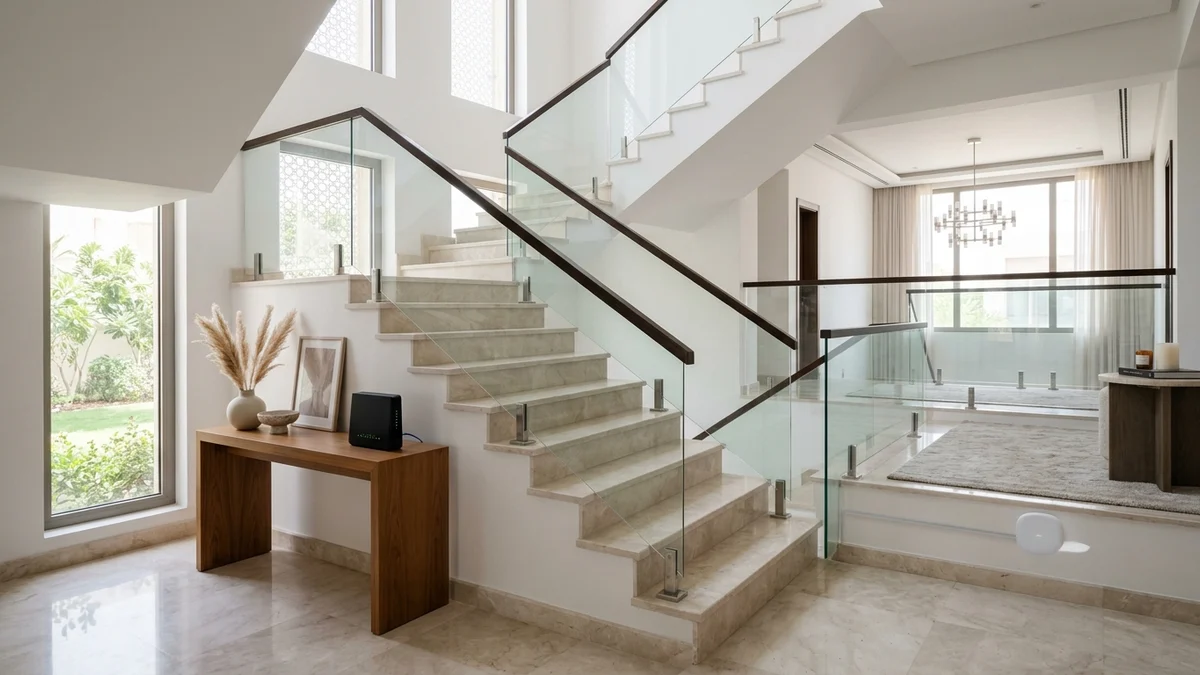
Residential architecture in Riyadh, Jeddah, Dammam, and across the Kingdom differs fundamentally from the timber-frame and drywall houses for which consumer Wi-Fi routers are typically marketed in North America and Europe. A typical Saudi villa spans 350 to 900+ square meters across three vertical levels plus courtyard structures: the Ground Floor (housing the formal men's Majlis, women's salon, dining hall, family living hall, kitchen, and an outdoor courtyard annex or Diwaniya), the First Floor (containing four to five bedroom suites and an upstairs family lounge), and the Second Floor / Rooftop Annex (often used as a gaming room, home office, gym, or domestic quarters).
When a telecom technician installs your Optical Network Terminal (ONT) inside a metal box near the ground-floor entrance or behind the main living-room television, the router's radio transmitter—regulated to a maximum Equivalent Isotropically Radiated Power (EIRP) of 100 to 200 milliwatts under spectrum rules enforced by the Communications, Space and Technology Commission (CST)—collides with four severe physical attenuators:
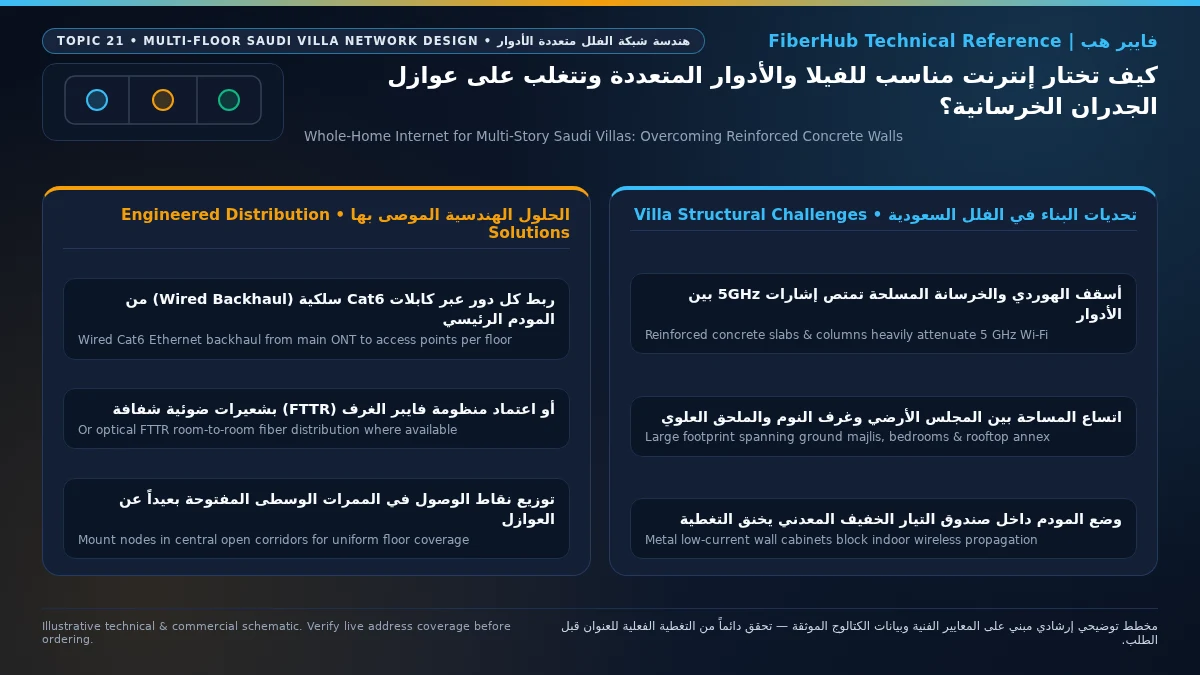
- Steel Rebar Meshes in Hordi Concrete Slabs (The Faraday Effect): Reinforced concrete ceilings separating the ground floor from the first floor contain dense grids of intersecting steel reinforcement bars. When high-frequency 5 GHz and 6 GHz Wi-Fi waves (whose wavelengths measure just 5 to 6 centimeters) hit a 30 cm concrete slab laced with steel rebar, the metal grid reflects and scatters the electromagnetic wavefront, inflicting 26 to 35 decibels (dB) of signal loss across a single floor transition. Because the decibel scale is logarithmic, a 30 dB loss means 99.9% of the wireless signal energy is absorbed or reflected before reaching the room directly above.
- Thermally Insulated Block Walls and Stone Cladding: Modern Saudi Building Code thermal regulations mandate insulated concrete blocks (sandwiching polystyrene or volcanic perlite) alongside interior marble, porcelain tiles, and decorative gypsum boards. Each interior partition wall strips away 12 to 20 dB of 5 GHz signal strength, isolating the front men's Majlis from the central family living area.
- Elevator Shafts and Security Doors: Many multi-story villas feature a central hydraulic or traction elevator enclosed by thick reinforced concrete shear walls and heavy steel doors. This vertical metal core creates a total RF shadow zone directly behind the shaft on every floor.
- Client Device Return-Path Starvation: Even if a high-power router downstairs manages to push a faint 2.4 GHz signal into an upstairs bedroom—causing your smartphone to display two bars of Wi-Fi—your phone's tiny internal battery-saving antenna only transmits at 15 to 30 milliwatts. Your phone simply cannot punch its return acknowledgment packets back down through the concrete floor slab, resulting in frozen pages and dropped calls.
| Structural Barrier Inside a Saudi Villa | 2.4 GHz Signal Attenuation | 5 GHz / 6 GHz Signal Attenuation | Real-World Impact on a 500 Mbps Plan Behind Barrier |
|---|---|---|---|
| Interior Insulated Cement Block Wall (20 cm) | -10 dB to -14 dB | -15 dB to -22 dB | Speed drops to ~180–250 Mbps in adjacent room |
| Reinforced Concrete / Hordi Floor Slab (30 cm) | -18 dB to -25 dB | -26 dB to -35 dB | Upstairs speed collapses below 15–30 Mbps or disconnects |
| Concrete Elevator Shaft & Steel Doors | -22 dB to -30 dB | -30 dB to -45 dB | Complete dead zone immediately behind elevator core |
| Double-Glazed Thermal Low-E Courtyard Glass | -12 dB to -16 dB | -18 dB to -26 dB | Outdoor Diwaniya / Mulhaq receives almost zero indoor Wi-Fi |
The Three Engineering Architectures for Whole-Villa Coverage
To deliver true gigabit speeds across all three floors and outdoor annexes, you must match your networking hardware to your villa's existing cabling infrastructure:
1. Wired Cat6/Cat6A Ethernet Backhaul (Ceiling APs or Wired Mesh) — Best for Pre-Wired Villas
If your villa already has in-wall Ethernet conduits terminating at RJ45 wall plates in each living hall and bedroom, and converging at a central Low-Current Distribution Cabinet (صندوق التيار الخفيف), you possess the gold-standard foundation. Place your ISP fiber ONT inside the central cabinet, connect it to a Gigabit or 2.5G PoE (Power over Ethernet) switch, and activate the in-wall Cat6/Cat6A cables installed according to ANSI/TIA-568 structured cabling standards. Attach either ceiling-mounted Wi-Fi 6/6E Access Points or consumer Mesh nodes operating in Wired Access Point / Ethernet Backhaul mode on each floor.
- Why It Wins: Because inter-floor traffic travels over solid-core copper Ethernet cables rather than trying to penetrate concrete ceilings wirelessly, there is zero inter-floor speed loss. A 500 Mbps fiber plan downstairs delivers the exact same 500 Mbps and 2 ms latency in the rooftop annex.
2. Fiber to the Room (FTTR) — Best for Finished Villas Without Ethernet Conduits
Many homeowners move into a finished villa only to discover that the builder never installed Ethernet cables between floors, or that existing telephone conduits are blocked—and they understandably refuse to drill through marble walls or run unsightly plastic cable trunking across finished ceilings. Fiber to the Room (FTTR), offered directly as a turnkey service by STC, Mobily, and Salam, solves this architectural dilemma cleanly. In an FTTR installation, specialized technicians route ultra-thin, transparent, bend-insensitive optical fiber cables (just 1.2 to 2 mm thick) seamlessly along baseboard moldings, door frames, or existing micro-ducts using precision thermal bonding tools that leave the fiber virtually invisible against painted walls. The main optical gateway (Master ONT) downstairs feeds pure laser light to compact optical Wi-Fi 6 satellite units (Slave ONTs) on the first floor and rooftop annex. Because optical glass has no distance attenuation across a villa, every floor receives full gigabit capacity with hardware-Coordinated Seamless Roaming (IEEE 802.11k/v/r).
Separate indoor Wi-Fi bottlenecks from line capacity issues
If slow speeds or high ping persist over direct Ethernet, check whether fiber or a higher upload tier is available at your address.
3. Tri-Band Wireless Mesh via Open Stairwell Line-of-Sight — When No Wiring Is Possible
If you want a self-installed wireless solution without running Ethernet or optical fibers, never buy cheap single-band Wi-Fi range extenders—they cut throughput by 50% on every hop and trap your phone on weak signals. Instead, invest in a Tri-Band Wi-Fi 6 or Wi-Fi 6E Mesh System certified by the Wi-Fi Alliance that dedicates a separate high-capacity 5 GHz (4x4 MIMO) or 6 GHz radio band exclusively to node-to-node backhaul communication.
- The Stairwell Placement Rule: Do not place the upstairs mesh node inside a closed bedroom directly above the downstairs router (forcing the backhaul signal through the concrete slab). Instead, position the ground-floor node, first-floor node, and second-floor node along the open internal staircase atrium (بيت الدرج). Because the open stairwell provides an unobstructed air shaft connecting all three levels, the mesh nodes communicate at high speeds without passing through reinforced concrete ceilings!
Floor-by-Floor Placement Blueprint for a Typical Saudi Villa
To eliminate dead zones in both indoor rooms and outdoor seating areas, design your node layout around four distinct functional zones:
- Ground Floor (Family Hall + Formal Men's Majlis): Because Saudi villas physically separate the formal guest wing (Majlis and dining room) from the private family hall with heavy doors and privacy walls, a single router in the family hall often leaves the front Majlis with weak reception. Place your primary gateway in the central family hall and run a secondary wired AP or mesh node toward the front Majlis entrance.
- Outdoor Courtyard Annex (Mulhaq / Diwaniya): Exterior villa walls and Low-E thermal glass patio doors block almost all indoor 5 GHz Wi-Fi from reaching the outdoor annex. Always pull a dedicated outdoor-rated Cat6 cable (or FTTR fiber line) through the underground garden electrical/intercom conduit to mount a dedicated access point inside the Diwaniya.
- First Floor (Master Suite + Children's Bedrooms): Mount your first-floor access point or FTTR unit in the central upstairs family lounge (صالة الدور الأول) so that its signal only has to cross a single bedroom door or partition wall to reach each sleeping suite. For the master bedroom or an upstairs study desk, activate the room's dedicated RJ45 wall jack for stationary TVs and computers.
- Second Floor / Rooftop Annex: Because the rooftop annex sits behind two concrete floor slabs, it requires its own wired Ethernet drop or FTTR optical satellite unit to support low-latency gaming consoles, remote work desks, and rooftop terrace seating.
You can verify which fiber and FTTR operators currently serve your neighborhood by entering your location in the national address broadband coverage tool.
Comparing Verified FTTR and High-Speed Villa Fiber Plans in Saudi Arabia (VAT Inclusive)
Saudi telecom providers offer both turnkey FTTR room-fiber packages (which bundle the master optical gateway, room satellite units, and professional installation) and standalone high-speed FTTH plans for villas that already own wired mesh or PoE access points (all monthly prices below include 15% VAT per official tariff schedules):
- Turnkey Fiber-to-the-Room (FTTR) Villa Packages:
- Salam: Offers the broadest FTTR lineup starting with
Salam Home FTTR 300(300 Mbps download / 100 Mbps upload) at 345 SAR/month,Salam Home FTTR 500(500/125 Mbps) at 402.5 SAR/month, and the flagshipSalam Home FTTR 1000(1000/300 Mbps) at 575 SAR/month. - Mobily: Provides three dedicated tiers including
Mobily Home FTTR 400 Mbps(400/100 Mbps) at 402.5 SAR/month,Mobily Home FTTR 500 Mbps(500/125 Mbps) at 460 SAR/month, andMobily Home FTTR 1 Gbps(1000/300 Mbps) at 920 SAR/month. - STC: Offers
STC Baity Fiber Plus FTTRdelivering 500 Mbps download and 125 Mbps upload at 488.75 SAR/month with optical room distribution included.
- Salam: Offers the broadest FTTR lineup starting with
- Standard High-Capacity FTTH Plans for Pre-Wired Villas (500 Mbps to 1 Gbps):
If your villa already has Cat6 cabling and your own mesh/AP hardware, standard FTTH tiers deliver exceptional value: in the 500 Mbps class,
Salam Fiber 500is 345 SAR/month,Zain Fiber Home Premium (500 Mbps)(with 200 Mbps upload) is 389 SAR/month,STC Baity Fiber Stream (500 Mbps)is 402.5 SAR/month, andSTC Baity Fiber 500andMobily Fiber Postpaid 500are 460 SAR/month. In the 1 Gbps class for expansive estates,Salam Fiber 1000 (Gigabit)is 460 SAR/month,STC Baity Fiber Max (1 Gbps)andMobily Fiber Postpaid 1GBare 920 SAR/month, andZain Fiber Home Black (1 Gbps)is 949 SAR/month.
Compare all villa-ready broadband packages side by side on our broadband comparison page, or browse Saudi fiber and FTTR plans and the full internet plans directory.
Pre-Wiring Checklist for Villa Owners—and Why Powerline Adapters Fail
If you are building a villa at the structural ("Azm") stage or upgrading an existing property, following these low-current engineering rules will save thousands of riyals and prevent frustrating hardware mistakes:
- Install a Ventilated Central Low-Current Cabinet (صندوق التيار الخفيف): Avoid cramming network switches into a tiny 20x20 cm plastic junction box. Install a 40x60 cm structured media enclosure on the ground or first floor with a dual 220V AC power outlet inside, connected to the exterior street boundary box via a smooth, dedicated 25–32 mm conduit for the ISP fiber pull.
- Pull 100% Pure Solid Copper Cat6A Cables: Never allow contractors to pull cheap Copper-Clad Aluminum (CCA) cables, which become brittle over time and overheat under Power over Ethernet (PoE). Run pure copper Cat6A drops to the ceiling center of every floor's living hall for ceiling APs, behind every wall-mounted TV location, and through an underground conduit out to the courtyard Mulhaq and perimeter security cameras.
- Avoid Electrical Powerline Adapters in Three-Phase Saudi Villas: Homeowners often try plug-in Powerline adapters to send internet over AC electrical wiring, only to find they barely reach 15 Mbps or fail to pair between floors. Saudi villas are supplied with Three-Phase (380V/220V) electrical distribution, where electricians wire the ground floor on Phase L1, the first floor on Phase L2, and the rooftop annex on Phase L3—blocking high-frequency Powerline carrier signals between floors—while heavy inverter air-conditioning compressors inject severe line noise. If your finished villa lacks Ethernet cables and you prefer not to subscribe to FTTR, use MoCA 2.5 (Multimedia over Coax) adapters over existing in-wall satellite TV coaxial cables to create a rock-solid 1 Gbps wired backbone between floors.
Frequently Asked Questions About Multi-Story Villa Broadband in Saudi Arabia
Does your current plan support your device count and upload needs?
Compare download/upload ratios and Wi-Fi 6 or FTTR hardware options across plans available at your address.
Is FTTR (Fiber to the Room) better than buying my own Wi-Fi Mesh system for a villa?
It depends on your wall conduits. If your villa has no Ethernet cables running between floors, ISP-installed FTTR is superior because technicians lay ultra-thin optical fiber directly to upstairs rooms, bypassing concrete ceiling loss completely. If your villa already has RJ45 Cat6 wall ports on every floor, buying a Wi-Fi 6/6E Mesh system or PoE ceiling access points and plugging them into those wired ports achieves identical gigabit performance with full ownership of your hardware.
How do I get strong internet in the outdoor courtyard annex (Mulhaq / Diwaniya)?
Wireless signals from inside the main villa rarely survive the insulated exterior wall and double-glazed thermal patio windows. The reliable solution is to pull an outdoor-rated Cat6 Ethernet cable (or FTTR fiber) through the underground garden electrical or intercom conduit connecting the main house to the Mulhaq, and install a dedicated access point inside the annex.
Will my phone disconnect from WhatsApp calls when I walk upstairs between mesh or FTTR units?
No, provided all units in your villa belong to a unified Mesh or FTTR system configured with a single network name (SSID) and IEEE 802.11k/v/r fast-roaming protocols enabled. These standards allow the network to hand your smartphone off from the ground-floor unit to the first-floor unit in under 50 milliseconds without dropping active voice or video calls.
What broadband speed tier is recommended for a 3-story Saudi villa with 6 to 8 residents?
We recommend a minimum of 500 Mbps (or 300 Mbps for smaller families) on FTTH or FTTR. In a multi-story villa with multiple living halls, bedrooms, smart security cameras, 4K TVs, and gaming consoles operating concurrently, a 500 Mbps to 1 Gbps tier ensures that heavy downloads on one floor never slow down users on another floor.
What is the best solution for a large villa in a new neighborhood that only has 5G coverage?
Do not place an indoor 5G router on the ground floor of a three-story concrete villa. Instead, mount an outdoor 5G CPE receiver on the rooftop mast where line-of-sight cellular signal is strongest, run a single Cat6 PoE cable down into your villa's central low-current distribution cabinet, and distribute that connection across all three floors using wired indoor Wi-Fi 6 access points. You can explore compatible wireless plans on our 5G home broadband page.
Completed tuning and ready for a more stable fiber line?
Check fiber availability at your address and compare low-latency plans for gaming, telework, and multi-floor homes.
Editorial Transparency & Neutrality Notice:
This guide is provided for comparison and decision support. It does not constitute final address coverage confirmation, binding operator pricing, or regulatory accreditation. Always verify final plan terms and box readiness before completing your subscription request.